Search This Blog

Showing posts with label Time Travel. Show all posts

Tuesday, December 24, 2019

A CHRISTMAS CAROL 1938

When it came to picking to review an adaptation of "A Christmas Carol", I was originally going to review the film starring Alistair Sims since that is the version that many people would consider the ultimate film telling of the story. Just as I was getting ready to start watching it, I remembered the film adaptation that came out in 1938.

A CHRISTMAS CAROL  (1938)  Charles Dickens classic.  Original half sheet, 22x28, style A, movie poster.

Since there were very few full-length film versions of the film with sound prior to it, I have decided to cover the 1938 film first before talking about the film that many would argue to be the best version of the story. As always, there are tons of things to cover when dissecting "A Christmas Carol" adaptation, so let’s jump right into the first part of the story.

EBENEEZER SCROOGE

chris4-2

The actor who was originally set to portray Ebenezer Scrooge was the late great Lionel Barrymore, who was popular for playing the miserable miser every holiday season on the radio. Barrymore was committed to playing his famous radio role on the big screen; however, life had other plans for him. With arthritis taking a toll on him, he had to step down from the role. Fortunately, he was still able to help with the film by recommending his friend Reginald Owen to play the role (who you may know him as Admiral Boom from "Mary Poppins"). Barrymore chose not to play Scrooge on the radio fearing that it would hurt the success of the film, so he decided to promote the film in the film's trailer. It's a real shame that he couldn't play the part, because it would have been fantastic to see such a grand actor play this famous character on the big screen. But I suppose this was something that was meant to be regarding Barrymore's career. 8 years later he would play a miser who is much worse than Scrooge, who is non-other than Mr. Potter from "It's a Wonderful Life". I can only believe that if he were to play Scrooge in the film, and then play Mr. Potter, he would probably be less seen as one of the great villains in cinema and more as Barrymore in a type casted role for how similar he is to a famous Christmas character he would have played, just without redemption.

Now that Owen is in the lead, he in this portion does make for a good grouchy bitter-old Scrooge. He hits all the right notes when conducting Scrooge's hatred for Christmas, from his sour face, and commanding voice (though the scene when he gives Cratchit off for Christmas was too quickly paced). His interaction with his Nephew Fred (Barry MacKay) and the two Portly Gentlemen are carried out traditionally well, but his best moments is how he handles his employee Bob Cratchit (Gene Lockhart). Some of the things he says to him are so hurtfully demeaning that you can only imagine what kind of other terrible things that Scrooge says to him to keep his spirits low. For instance, when Bob Cratchit tells him that he was working a half hour overtime, Scrooge demands him to "close up" before he "makes something of himself". Scrooge later on states that he can easily "find a man more capable" than him, which is something he's clearly told him before. I know that the versions of Cratchit have had it rough, but my goodness I would be going into a deep depression if I had to keep on being told I am worthless as I work in a freezing environment with little pay. It rather amazes me how Cratchit has to put up with this for so long.

Despite that we know so much about Scrooge's hatred for Christmas, most of this is portion is focused on Fred and Cratchit. Right from the very start of the film, rather than seeing Scrooge walking, or the film going directly to his place of business after looking at the winter scenery in London, for the first few minutes we follow Fred as he strolls off to see his Uncle. And through those few minutes we see him slide on the ice with the kids where he meets Bob's son Tiny Tim (Terry Kilburn), who he places him on his shoulders as he slides on the ice. It's a nice moment, although it does replace a moment that Cratchit usually takes part in that just doesn't feel appropriate to switch him off with another character. Still the dialogue he exchanges with Tim about how he knows Scrooge, does give some nice build-up to leads nasty personality for how the kids fear him. The most interesting part about Fred in this version is unlike most versions when he enters the office with Scrooge present, he arrives when Scrooge is away with only Cratchit present. Noticing how Cratchit must be miserable working under these conditions he decides to spread a little Christmas joy to him, at the cost of breaking a few rules, such as adding coal to the fire, and taking one of Scrooge's glasses for a sip of wine he has brought. Though Fred only means well, his interference nearly causes Cratchit to be fired when Scrooge finally enters the screen. It's not a bad change of having a character who's always so perfect make a few careless mistakes for how consumed he is with sharing the joys of Christmas. Sometimes people in reality do find themselves making foolish decisions based on their blind love for the holidays without realizing that there could be repercussions to the people around them, if not just for them self. In terms of performance, MacKay is a little more grounded compared to other performances of the character. As most actors almost seem like their phoning in Fred's kind nature, MacKay though just as upbeat as the other actors who played Fred, seems more dignified. He is sophisticated, but he still does not shy away from his enthusiasm for Christmas.

Lockhart isn't a bad Cratchit either. His nervous bumbling personality for whenever he's around Scrooge does sell that his boss is not a man to be tried with. You always feel that he's walking on egg shells for how much he fears his boss, knowing that he could be fired at any time. While capturing the characters frightened side, he manages to pull off his fun child-like personality just as well (however, his sudden joy when he sees a goose is kind of creepy). In an interesting change of events, Cratchit gets dismissed from his position. Due to his child-like love for Christmas as he's showing kids how to make a better snowball to get a better hit at their target, the hat he throws the snowball at belongs to his employer. We all know in the end he's going to get his job back, however this new idea of creating tension between Cratchit and Scrooge does seem a little more engaging. Scrooge this time isn't going to see the present with Bob Cratchit still working for his business. He is going to be witnessing a Christmas without having a job to go back to after the holiday, which will no doubt lead to a grim future because of his action. I don't want to talk too much about it since there is much more to see, all I'm going to say is this change puts Scrooge in a more direct position with handling Tim's death than he did in the original story, which I find to be twice as heartbreaking of a concept.

If you read my review on the first sound film of the storywith Seymour Hicks in the leading role, I talked about how dreary and unpleasant most of London looked during Christmas time. I get that it wasn't the most cheerful environment back where the story takes place, but that doesn't mean they didn't have to make it not look festive given that it's a fantasy Christmas story. Well this version certainly improves upon the last adaptation. Right after the opening credits as we hear a beautiful rendition of "Hark the Herald", we view the city at night covered in snow that looks as lovely as a Christmas card, as opposed to feeling ominous to the point where there is little cheer to be felt. Watching the kids slide on the ice and throw around snowballs, as people walk the town to shop for tasty Christmas treats sets up the film's holiday mood on the right track for how festive it is but not to the point where everything is perfect, (there are kid Christmas Carolers singing out of key). Appropriately, the only gloomy looking place that we see in the city is the street where Scrooge works looking as unwelcoming as the very person who runs it.

MARLEY'S GHOST

cc 1938 marley

The film visually so far looks better than the previous film; however, there are times when the film can look too pretty, where it loses the terror that a scene is supposed to have. For instance, before Jacob Marley appears there is always some kind of tension building-up to his full reveal. Scrooge's home looks run-down for how empty and covered in cobwebs the interiors are, as if he's living a haunted house. The music played in the background sounds otherworldly, as there is a feeling that something is following Scrooge for how the music would stop when Scrooge stops walking, to resuming when he does. Just as Scrooge is going to call it day, he goes from hearing his doorbell ringing to suddenly hearing all kinds of bells ringing loudly in his ear. The set and sounds are all perfect for this build-up, except that the lighting is excessively bright. Unlike how most versions use shadows and little lighting to create a sense of fear for when Marley is to appear, this version looks as if Scrooge is searching his house with the lights on, which isn't scary. Perhaps if the pacing was slower and the cinematography brought a little more weight with the visuals, the lighting wouldn't be as distracting. But those elements are just as off. The cinematography is very standard, as the pacing for Scrooge walking through his house moves so fast that it feels that the film just wants to show Marley as quickly as possible. The scene when Scrooge sees Marley on his doorknocker hardly takes its time for it to be creepy. Marley face quickly appears (through a decent effect), and Scrooge exclaims his name so quickly that he seems annoyed by him being on his door, than fearing that he's a ghost.

As weak as the build-up is, we at least get to see Marley on-screen, as opposed to seeing him invisible, making this the first sound version of the story to have Marley on-screen. The effects for Marley's ghostly appearance along with his make-up are good, but the performance from Hitchcock actor Leo G. Carroll I would say appears almost as bored as Ed Asner was with Tim Curry. I say almost because his supernatural voice is creepy, his cold-stare is chilling, and when showing regret for his actions when he was alive does feel melancholy. But for the most part, unlike how most portrayals of Marley's ghost are either intimidating for how aggressive he is towards Scrooge, constantly in agonizing pain, or both, Carroll doesn't seem to be giving much in his performance. He for the most part carries no emotion when helping his former partner from the terrible fate he suffers, who doesn't change his tone or expressions. Even his moaning from this endless pain sounds non-nonchalant. Scrooge at one point shuts him up because of it, when Marley should be the one who is overpowering him. Owen's frighten delivery doesn't help much either for how rehearsed it sounds. And just so the film can throw something new for the sake of it, the scene stops dead in its tracks when Scrooge summons the authorities in to arrest Marley, only for them to laugh at Scrooge since they can't see him.

GHOST OF CHRISTMAS PAST

Image result for a christmas carol 1938 ghost of christmas past"

In the previous sound film, we saw nothing of the Ghost of Christmas Past. There was a silhouette of the spirit taking the form of a man in its first reveal, but after that, it was just a blurry light. Well this version doesn't make the same mistake again, it makes a new one. Playing the ghost is Ann Rutherford, who does a fine job of capturing the spirit's humble personality. It's just unlike how Marley appeared ghostly, the ghost's appearance is pretty underwhelming. Apart from how she and Scrooge fly, there are no special effects supporting the fact that she is a spirit. Not to say that special effects that involve us seeing through them is always needed. But it looks like Rutherford's doing a local live stage show as opposed to a theatrical film since her costume looks like something that would be worn at a Christmas pageant. I am just always aware that someone in a tacky costume is playing the ghost, which is very distracting considering how nice everyone else looks in the film.

If you once again remember my review on the first sound version of the story, I expressed great disappointment that the film skipped many details involving Scrooge's past. Here, we see Scrooge's humble beginnings before he turned into a miser, starting with his childhood. Owen's portrayal of Scrooge's loving nostalgia when visiting the past feels very warm for how pleasantly excited and sentimental he is. At times, it gets a little too exaggerated but you still feel the sweetness in his performance. The whole childhood sequence takes place at the schoolhouse where young Scrooge stays during Christmas at the demand of his Father, until his little sister Fan tells him that the plans have changed. The scene visually showing young Scrooge's isolation after seeing everyone leaving is handled effectively for how empty and downbeat the school appears with Scrooge walking alone to suddenly crying after behaving as if he is fine with it before his friends leave. The downside is the kid playing Scrooge is very off with his delivery, who gives a awkward performance. To be fair, it's not just him because the other kids he talks to are as wooden as him. That is with the exception of Fan, who is a little over the top cutesy, but since that is usually Fan's personality; I can't say that it's out of place.

The first sound actor to portray Fezziwig is Forrester Harvey who has previously appeared in small roles in horror classics such as "The Invisible Man" and "Frankenstein". His portrayal of Fezziwig stays true to the character's jolly fun loving personality. Adding to the sweetness of Scrooge's visit to this part of his past is we're watching Fezziwig interact with Scrooge when he's still a teen as opposed to a young adult. It is just very heartwarming to see a kid who has had a miserable childhood regain some of it as he is still growing-up with a boss who treats him like family instead of a regular employee. The scene is then followed by a great scene of Scrooge expressing his conflicts to the spirit of being a good boss and a cold businessman.

Fezziwig's Christmas party is not shown in this version, which isn't as much of loss when compared to what happens next. The ghost informs Scrooge that she is about to show him the black years of his life when he descended into the selfish businessman he has become. Scrooge grows terrified for what he's about to see wishing for the spirit not to show him that part of his past. When it doesn't seem that she will listen, Scrooge covers the ghost's head with her cloak, and finds himself waking up holding a pillow in his grasp. This is just as stupid as cutting out Scrooge's childhood! This is the point of the story where Scrooge must reflect on what has happened to him in the past both good and bad, before thinking about what he can do in the present to assure himself a better path than the one that is leading him. And the fact that the film decides to jump passed the times in his life that have changed him for the worst (after giving such intense build-up to it mind you) is an absolute disgrace! It doesn't matter how well people the know the story, Scrooge gaining love and losing it from greed is an essential part of the story that should never ever be left out!

GHOST OF CHRISTMAS PRESENT

Image result for a christmas carol 1938 ghost of christmas present"

An example of a ghost that can still appear as unusual without the need of effects to see through them is the Ghost of Christmas Present. From his costume design, to his make-up, you look at him and you'd buy that he's not a man from this world in the same way one would view Santa Claus. Beyond that, Lionel Braham sells this role. Unlike how the first sound actor playing the character was giving half a performance, Braham fully embraces the role! The amount of energy and passion he brings to this performance feels just as big and grand as the character is written. I barely see an actor hamming it up. I only see the character. An interesting new feature that the ghost wields is a magic horn that sprinkle magic to give sour people on the holiday Christmas joy. The idea is cool. It fits the character's gleeful personality and it is delightful seeing Scrooge willing aid the spirit after finding himself amazed by it. But ignoring how obvious that there's a flashlight underneath this festive looking prop when he uses it, this idea does indeed lead to a ton of questions. Why can’t the ghost make Scrooge happy with his magic? If he has tried it on him what prevents the powers from working? What are the lengths that these powers go too? Is the Christmas cheer that it brings mostly comes from brainwashing people's minds? But oh details, details, details. I guess if we can overlook the details involving Santa, I think we can tolerate a magical horn that brings good feelings.

Before Scrooge visits the homes of Bob and Fred, there's a scene where he watches them all singing together in a church, to then sliding on frozen ice in front of the church. There are some nice moments here, like how Scrooge acknowledges the love between Fred and his fiancé Bess (Lynne Carver) when they sing together, only for the spirit to challenge scrooge's emotions by reminding him of what he said about love earlier. It's a nice scene, though it isn't as effective as it should be with Scrooge's relationship with Belle being cut. Shortly after, Fred tries to convince Bess to slide on the ice with him, though a bit corny, it's still cute to see the two interacting outside of the scene when Fred hosts his Christmas party. Moreover, the party scene that's shown before Scrooge meets the Ghost of Christmas Yet to Come is handled well, as they toast to pity Scrooge and play a game involving a blindfold. The real highlight of the scene is Scrooge's delight to watching all of this just as the ghost is about to leave telling him he is a fool for loving Christmas, which Scrooge fully denies. Owen sounds authentic when he wants to stay, and his love and excitement for the holiday is joyful. The only thing odd is his laughter coming off as more sinister than it is out of pure love.

Going back to the church scene, as much as I would expect Bob and Tim to be there, it does feel a little early for Scrooge to feel sorry for the boy without really getting a feel of his personality. Don't get me wrong, I'd pity any child I'd see living in a terrible condition. Yet for someone as sour as Scrooge is, he is not the kind of man will instantly look at a kid and feel bad for him or her. It takes Scrooge to see what a sweet and genuine child Tiny Tim is before appearing concerned, which we see neither before this change in his character. The scene at the Cratchit's home is played as happily as one would expect (with the exception of Tim awkwardly wanting to stroke the turkey), but even there are a few alterations that are not needed. Earlier in the film, we already meet Cratchit's family when he brings home the food, thus taking away the emotions we are supposed to have with Scrooge when he sees that Bob has a family and loves spending time with them since we already get a scene showing it just without him. The family themselves don't appear to be doing bad financially either. I don't know what Bob does with the little he makes from his job, but it seems he's living better than most versions of the character given how nice his home is. The added subplot of Bob being sacked does come back when he tells his oldest daughter about it, who only feels worse about telling her knowing that the family finding out won't be make him feel any better. And instead of Bob toasting Scrooge's health, it's his wife (Kathleen Lockhart) who proposes it as Bob stands there looking uncomfortable. This reverse in the role does seem appropriate. It would seem out of character if Bob defended Scrooge if his Wife protests against it after being fired. And as we're enjoying this nice Christmas dinner, I do like it has a bit of an edge that Bob's family will soon be evicted from his house that will lead to Tiny Tim's demise. As questionable as how they live may seem, Scrooge firing Cratchit does make-up for it now that they have no source of income.

THE GHOST OF CHRISTMAS YET-TO-COME

Image result for a christmas carol 1938 ghost of christmas yet to coem"

Transitioning to the appearance of the Ghost of Christmas Yet-to-Come, we watch the events that we saw from the past and present appear in front of Scrooge's mind as he sleeps. Scrooge still laughing with joy (then why show him sleeping if he's not going to wake up) stops when he finds himself up on a mountain near sprawl trees as the Ghost slowly walks towards him. The atmosphere for this scene is appropriately gothic for having a set resembling something you'd see from a German Expressionism film, that's carried by eerie sound effects and an unsettling score to make it feel foreboding. It would be perfect if it didn't look so bright because shadows and darkness don't play a big factor with setting the mood. The only dark image is the Ghost itself who this time is a person in a costume as opposed to being a shadow on the wall. There is not too much to say about the Ghost's presence or design since it sticks to its traditional grim reaper design as it says nothing and just points the way.

As usual, Scrooge is taken to see a couple of businessmen discussing about his demise showing no sympathy. Like I can say for many of the other versions of the scene, its acted well as it follows the material faithfully. The only amusing change is when one of the men is disappointed that he wasn't left with anything making him realize that Scrooge was never his friend after the many conversations they would share together. It's a pity we never see a scene showing it prior to what's revealed, but then again in most versions, Scrooge is not usually seen chatting with any of them. Scrooge is then shown a dead body that it is hidden underneath the covers of the bed that it lies on. The scene only happens briefly with little to no thrill with playing on Scrooge's fear of who is underneath the sheets (unknown that he is dead in the future due to his name never being mentioned). Owen's reactions to this are off too as he at first feels shaky to then acting unfazed by it.
  
So with Bob out of the job while dealing with the loss of Tiny Tim, how is he and his family surviving? Are they in a workhouse, out on the street, gathering in Church, living in a small shack? For the film giving Bob a fear of his future without any work and how he'll family will respond to it, surely this will greatly ruin his future. Actually, apart from Tim dying, he seems to be fine financially. He's somehow still living in the same fancy home and nowhere in the scene is there a mention of how his family felt about him losing his job. The scene itself is still incredibly depressing from the performances of Gene Lockhart and Reginald Owen. I only wish the film would follow-up on Bob Cratchit's added subplot of losing his support for his family. This could have been an interesting new take on Bob's future, and the fact that it builds-up to nothing is as infuriatingly disappointing as not seeing the dark years of Scrooge's past.

Scrooge learns that his future self is dead when he's taken to the cemetery where his grave is. Once again, the set fits the grim depressing tone that we're supposed to feel for Scrooge as he enters, but it forgot to be dark because of the inappropriate use of lighting. It's not as bright as when Scrooge first met the ghost, however there are still rays of bright light shining through almost as if the light of heavens are above him. I guess it is supposed to symbolize his chance for redemption in this land of darkness, however since it has been used before Scrooge approaches his grave it looks out of place. Scrooge pleading to the spirit that he will change does overcome the lack of darkness that's supposed to be present. Owen isn't only portraying Scrooge as sad and fearful in this scene, he gives him some dignity as he promises the spirit that he will honor Christmas. The way he delivers his promise backed up with patriotic music comes across that he is proud to pledge his honor to Christmas. Yet while being prideful he is still vulnerable by coming across as shaky and distressed of if he still has a chance to set things right.

CHRISTMAS DAY
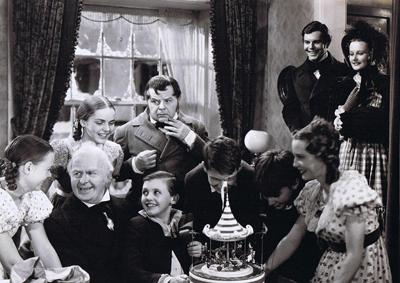
Image result for a christmas carol 1938"

The Christmas day portion of the film showing Scrooge's redemption is handled as sweet and heartwarming as one would love to see. Owen gives a lively and sentimental performance when portraying a reformed Scrooge. His interactions with the boy on the street, the Portly Gentlemen and Fred are nice gentle scenes with a little bit of humor that are exchanged extremely well by each actor. The best part of the sequence is the last scene. If you remember in the end of the Seymour Hicks film, Scrooge is never shown to be bonding with Cratchit's family or Tiny Tim. It just ends with him and Bob singing in church together. In this version, we get our first sound portrayal of Scrooge visiting the Cratchit household, only this is played a little more with laughs. When Scrooge drops by, he does not pretend to be his old-self, he enters with excitement carrying goodies scaring Bob and his wife. As they're in another room discussing Scrooge's odd behavior, they hear the sound of their children screaming thinking their being hurt, only for Bob to discover that they're playing with a beautiful toy carousel that Scrooge brought. As funny the scene it is, it does not lose track of the emotional connection that we are supposed to have from it. The film ends on a perfect note with everyone raising a glass (including Fred and Bess), Tiny Tim saying the most iconic Christmas quote of all time, and hearing the song "Silent Night" to close-out the film.

OVERALL THOUGHTS

The film is an improvement over the Seymour Hicks film, but it's just as hit and miss. The use of bright lights is overused. As great as it is to see the ghosts, the first two are disappointing from either an acting standpoint, or not looking the role. The added subplot of Bob Cratchit being sacked is incredibly pointless. And the removal of the dark years in Scrooge's past are unforgivable. With that said, the film is more visually pleasing than the previous one. Reginald Owen aside from a few awkward moments is a great fit for Scrooge. Most of the casting is spot-on! And plenty of the new scenes and ideas are nice little touches to get you into the Christmas spirit as Scrooge is. Neither one of the first two sound films are one of the best versions to offer. Nevertheless, this one hits a little closer to home than the first one. Let me put it this way. I will most likely be re-watching the 1938 film more times before choosing to sit in near total darkness seeing almost nothing with Seymour Hicks.

HAVE A MERRY CHRISTMAS AND A THIRD HAPPY NIGHT OF CHANUKAH!!

Wednesday, October 30, 2019

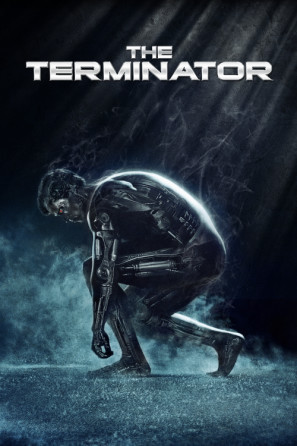
THE TERMINATOR: TERMINATED SCENES

Before I decide to review any of the Terminator films after James Cameron left the director's chair,  I'm going to review the deleted scenes from the first and second film to see if they were worth cutting out or should've been placed in the final film. Covering the first film will be much different from how I reviewed deleted scenes in the past because instead of me reviewing a special cut of the movie, I'm just looking at the deleted scenes found under the bonus features. Let's jump in the past and see if any of these didn't deserve to be terminated.

TERMINATED SCENES FROM

Image result for the terminator poster

WARNING: THERE WILL BE SPOILERS!

Image result for Terminator sarah waitress

In a less than 30 second scene, after Sarah punches in her time card at the restaurant, we cut to a shot of her locker (with her name on it) and see her walk up to a mirror criticizing her wholesome image at a job she hates. The reason why this scene is cut is for being just as self-explanatory as the scenes of Sarah of working at her job. We already see her name when she punches in her time-card and watch her unhappily work at her job in the scene that follows. Why bother showing a middle to this with information we already know about her identity (TWICE in the same deleted scene, incase if someone in the audience can't read), and having a scene that visually shows her misery after? Nothing new is gained here.

Image result for Terminator 1984

In the scene when the Terminator kills the wrong Sarah Connor, the scene was originally going to end with the machine casually walking to its car as children and neighbors flee the scene. I can see why the scene was cut. It doesn't enhance the story in anyway. But I don't think it would've hurt the film if it was kept. The image of seeing this cyborg treating a killing it committed in public in broad daylight as if it just swated a fly, not caring or acknowledging the cries from the children (most likely one from the woman it killed) around it is incredibly chilling. It's pretty messed up the more I think about it. But then again what do you expect from a machine that's programmed to kill?

Image result for Terminator 1984 deleted scenes

Regarding authority figures in the first two films who saw Kyle and Sarah's stories about the future to be crazy, the only likable character in that category was Lieutenant Traxle. Unlike his sidekick Detective Vukovic, and Dr. Silberman who were very condescending and didn't always take their job seriously, Traxler always remained humble and professional. In the deleted scenes we see this character be given a bit of an arc. The first couple of scenes show him and Vukovic taking part in the chase after the shoot-out in the "Tech-Noir", that are so brief that their involvement in the chase is unneeded. But after Kyle's interview, we see Traxler standing silently puzzled about Kyle's story of the Terminator hoping that he is crazy. Towards the end of the shoot-out at the police station as Kyle and Sarah make their escape, they find him slowly dying, handing Kyle his gun telling him to do what he must to keep Sarah alive. Traxler believing Kyle's story doesn't add a lot to the plot, but given how much time we spent with him where he becomes the fourth important character in the movie for finding ways to warn Sarah and protect her, it seemed a little unsatisfying that he wasn't given much of a proper farewell. It's honestly refreshing to see in retrospect that someone who would accuse one of the main characters for insanity and lock them up for it, not only fully accepts that their sane when proven innocent but try to aide them before meeting their maker. This idea would be handled much better with Miles Dyson in the second film, but he's never shown trying to apprehend any of the protagonists, which is what makes Traxler's arc so amusing.

Related image

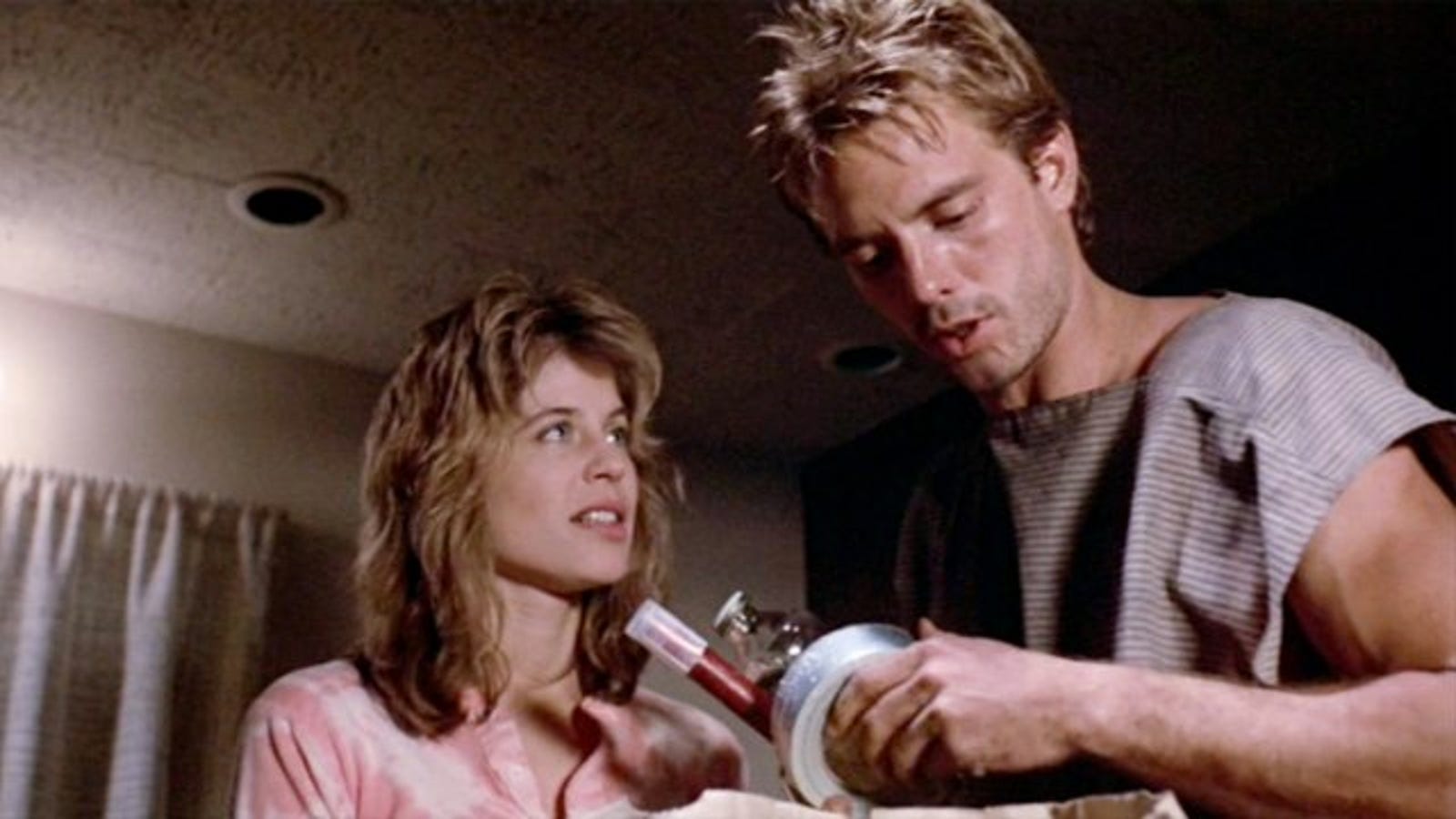
The following three Terminated scenes focus on the relationship between Sarah and Kyle. The first one happens after Sarah wakes up from her nightmare visions of the future. Sarah calls her Mother telling her to hide-out in the cabin, and she looks up the computer company responsible for the end of humanity "Cyberdyne System" in the phone book. Discovering the address, she tells Kyle her plan about blowing-up the company to prevent the future from happening. Kyle rejects the decision for not being part of his mission, and Sarah angrily runs-off and gets into a struggle with Kyle in the woods, eventually causing him to pull out his gun on her from his war instincts. Sarah cries to Kyle about not wanting to spend the rest of her life running away from the Terminator, but Kyle doesn't listen. Shocked by the beauty of the forest (the only place in the movie that isn't sleazy or dark and gloomy), Kyle slowly begins to break-down at how everything he sees is gone. Sarah comforts Kyle by telling him they can change it, causing Kyle to agree with her plan. This is the longest terminated scene out of the bunch, and while I know this scene will slow-down the tension, it's a very moving and character-driven scene. This is the moment where Sarah begins to take command, no longer being the innocent victim, which Hamilton gives a performance as powerful as she would be in the sequel where her character fully evolves. As Sarah has her moment of change, so does Kyle. Up until this scene, Kyle is always shown to be tough and angry, acting as strong and objective as a machine. All it takes for him to truly realize what is lost is how beautiful the world did look before the war, revealing the human side of his character since all his life he was trained to be a soldier which has dehumanized him. Biehn's acting does feel a little soap-operaish but his emotions are still felt. The best part about this scene is that Sarah's motivation to prevent the future from happening would have started here. In the context of the film's plot it doesn't feel needed, especially when its highly successful sequel has made perfect use of it. Still it's overall an excellent scene that develops these two characters so effectively.

Image result for Sarah and Kyle the terminator

As the two are making Pipe Bombs to blow-up "Cyberdyne", Sarah gets excited about showing Kyle what the past is like before the future. Kyle on the other hand is not too enthusiastic about it because he's still stuck with his mind set on war. Sarah hopes if their mission is successful the war will be over for Kyle, but to him it will never be over. In response to Kyle's feelings she now feels that she's officially part of the war after crossing paths with Kyle and the Terminator. This is a well-acted scene as Hamilton and Biehn still share such moving chemistry together. However, the stuff they talk about is already information we can easily gather ourselves that doesn't need to be spelled out to us. It does give a point to why Kyle is all of sudden making Pipe Bombs, but we can assume in the theatrical cut that he was going to use it on the Terminator after no longer feeling the need to follow Sarah around and wait for it to move-in so he can get a face of what the human-like cyborg looks like.

 Related image

Following the romantic sex scene, Sarah tickles Kyle as they are still lying in bed together. It's nice to see a moment with Kyle smiling showing what he could've been like if he lived in the past. It does a better job showing it than the brief scene when Kyle laughs from Sarah playfully toying around with him, since he's still in war mode. But it does break the tension of the chase scene that follows, and as sweet as it is, I'd much rather stick with Cameron's alternate option with showing Kyle being happy.

Related image

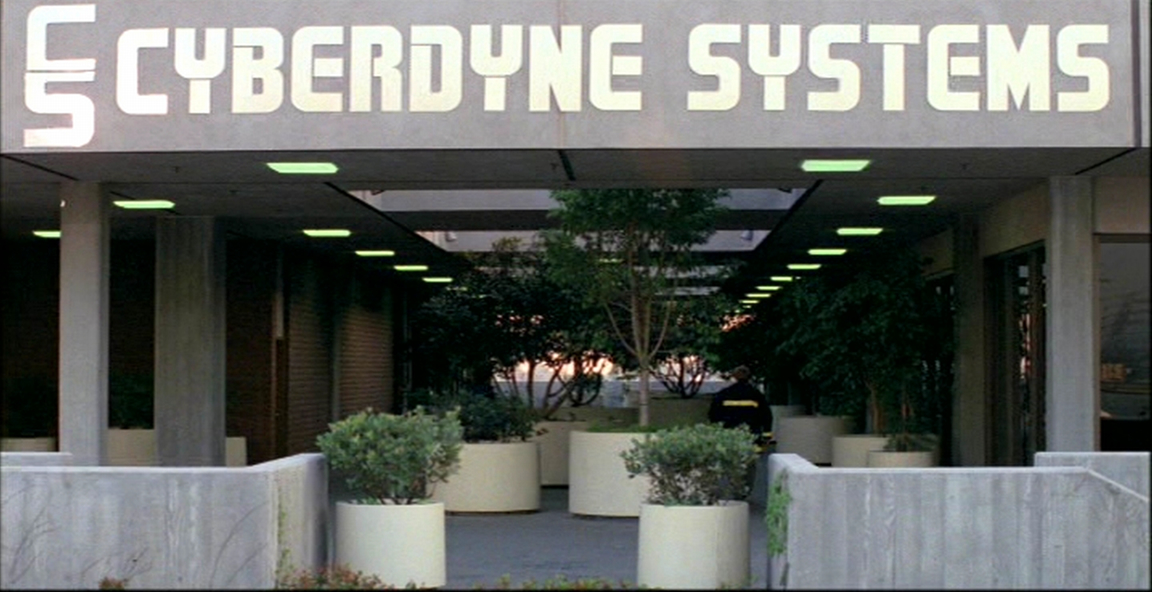
At the end of the climax before Sarah is taken to the hospital, we witness one of the heads inside the factory discovering the Terminator's computer chip after being dismantled with the intention to use it as inspiration for future projects. Once Sarah is brought inside the ambulance, the camera pans up as ominous music plays to reveal that the factory where Kyle and Sarah were when they fought against the Terminator was at the very same company that would be responsible for Judgement Day. Seeing this scene in retrospect with the second film in mind, while showing how they found the chip, we never see them find the mechanical arm nor is there any indication that it was already taken. Unknown to how they retrieved the arm without the authorities noticing it is a big plot-hole, making it seemed retcon in the second installment if it was left in. Though to be fair (not counting any other sources outside the films), it's never fully established how the Terminators in the second film were still able to cross through time after John Connor blew-up the time displacement equipment. Regardless if the scene makes sense or not in context to the second film, the reveal of where the climax took place and how the aftermath of it effects the future plays out like an ending to a "Twilight Zone" episode, making this realization eerie and full of dread.

OVERALL THOUGHTS

The absences for these scenes are quite valid as the film in its final cut works perfectly without them. The reason for this is because most of these scenes don't contribute much to the overall story for how short they are. With that said, I'd still be interested in seeing a cut of this film with most of these scenes edited into the film. Scenes like the cops taking part in the chase, the scenes with Sarah and Kyle in the kitchen and in bed, and Sarah looking at herself in the mirror wouldn't be missed for mainly stating and showing the obvious. But the rest of the scenes that follow are interesting, emotional, and scary. The Terminator walking away from the scene of the crime is uncomforting; Lieutenant Traxle believing in Kyle's story gives this character a perfect send-off; the scene with Kyle and Sarah in the woods nicely shows the character's evolving; and the reveal of "Cyberdyne Systems" is haunting. They're just great moments that deserve to be seen within the context of the movie. I'm not saying that an alternate cut of the film means to rid the theatrical version for good, it just would be highly amusing to see most of them restored for at least a limited time. If Cameron is willing to make an extended cut of the second film, I don't see why this should be an exception.

Monday, December 24, 2018

A CHRISTMAS CAROL (1997)

One of the most magical Christmas experiences that I've ever had growing up as a kid was seeing "A Christmas Carol" at Madison Square Garden. I saw the "Radio City Christmas Spectacular" as well at a very young age prior to it, and grew to admire it as I got older, but as a kid, I didn't care for it in the slightest. I actually used to loathe it for having no real story, being way too off the charts cheery, and having so much singing and dancing with very little breaks from it that it was unbearable. When I saw "A Christmas Carol" as my next Christmas musical in New York City, I was absolutely in love with it! It hit me on all the emotions that I'm supposed to feel; the changes that were made for the musical were fascinating and creative; the use of special effects for on stage and off stage stunned me; and I was dazzled by every single song and dance sequence than being annoyed by them. However, the number 1 reason why it became so special to me was that it starred an actor who I loved at that age, and that was Tim Curry who was casted in the role of Ebeneezer Scrooge, who fit the role so perfectly that I never once in my young mind at the time thought that this was the very same guy who I'd always have a blast watching in films like "Home Alone 2: Lost in New York", and "Muppet Treasure Island". As happy as I am to have the memory of the show, apart from him appearing at the "Macy's Thanksgiving Day Parade" with the rest of the cast from the play, I was never able to find footage of Tim Curry acting as Scrooge in the play or so much as a cast recording of it, which has disappointed me over the years because I've wanted to look closely at how Curry played the role after catching onto to his Curryisms as the years went by since I've seen him in the show. The closest that I could ever find myself watching Tim Curry playing Scrooge over and over, even as a small boy who was still getting goosebumps from the play, was in a straight-to-video animated musical film distributed by "DIC Entertainment".

Image result for a christmas carol 1997

I was first introduced to this film through my brother Jesse who saw it at his school (we were both in two different schools at the time) and he decided to show it to me after coming across it at "Blockbuster". The main appeal in the movie for us was Tim Curry as Scrooge, and his pet dog Debit (my brother was at the age when he was obsessed with owning a dog). We've rented the film once or twice after, to eventually owning a copy of a film. I have yet to revisit the film since my late elementary school years, so given the nostalgia factor for the cartoon and my love for Tim Curry; I chose this obscure animated feature of "A Christmas Carol" to cap off my holiday reviews. Please note that due to the lack of images I could find, this will be a picture-less review.

EBENEEZER SCROOGE

Out of the many qualities that Tim Curry provides as an actor is no matter what role he's given, he always puts on a show. It doesn't matter if he plays his role too over the top or is given a role that is so poorly written or in the film very little, because he always manages to entertain and bring as much life to his character as he possibly can. I say this because if there's one strong element in this cartoon that makes it worth seeing, its Tim Curry’s performance. His portrayal as nasty old Scrooge in the first 14 minutes of the film is simply fantastic on all levels of the character. He nails his cold and bitter personality down effortlessly by making his presence come off as intimidating, while also playing some moments up for a few laughs that don't feel out of character for how it stays true to the personality of Scrooge; like how he dismissively bids his nephew Fred "Good Afternoon" after being offered to join his family for dinner on Christmas, where his tone and mannerisms would shift to annoyed, to loud and cranky when Fred keeps on talking to him as he's about to leave. Curry doesn't make Scrooge appear to be completely bitter who just shouts "Bah Humbug", when he talks about Christmas being a time of year where people act like hypocrites, he sounds legitimately disgusted with the idea, feeling that he's the only honest person in the city who's not by pretending to be something that he's not for a certain time of year. However, Scrooge at one point does show a tiny bit of remorse when he sees Tiny Tim coming to pick-up his Father after almost nearly assaulting him, who is surprised at how tiny he is and that Cratchit is a family man. I do feel it’s way too early to be showing a bit of a sensitive side to this character, because the beauty of his encounter with the ghosts is we become more attached to him for how much we've learned about him and his life and see him act more and more sensitive through his life-changing experience that is incredibly different to the man we met earlier. I can't say that this moment is out of character because we know deep down inside that he isn't that heartless, I just find this kind of moment at this time to be very unnecessary.

Tim Curry's performance aside, there's nothing that I can say different about the portrayal of supporting characters that we meet here like Fred, the Portly Gentlemen, or Bob Cratchit (Michael York) that I haven't said about them in the past. Nothing about them that stands-out as anything different. The only supporting character who brings something new is Scrooge’s pet dog Debit (that sounds like he's shouting "Damn it" every time he angrily shouts the dog's name), a character not from the original story who was only created for the film because other animation studios big and small were trying to cash-in on the animal side-kick characters that Disney was doing at the time. And let's not forget that the famous Grinch who hated Christmas as much as Scrooge does had a dog for a side-kick too. However, unlike most pointless side-kicks in films not animated by Disney, I'll admit that it's a bit intriguing to see Scrooge have some kind of company at his side that isn't an object that he values. He (exactly like the Grinch) clearly doesn't show love for his dog either, he treats him just as nasty as the people he encounters, but seeing that dogs don't have the same capability as human's do and are trainable to meet his standards, he forces him to act as cruel as he is and uses him as his enforcer to frighten people away (like children and the Portly Gentlemen). Debit isn't entirely cruel because when Tiny Tim begins to play with him, he shows some actual happiness implying that he is a softie underneath his vicious tough bulldog image, however he must obey his master's commands and stick to what he's been taught to think and behave in order to eat and have a roof over his head. I'm not implying that Debit's presence is warranted, but for what they did (in this part of the film anyway), they didn't do a bad job. At least the film didn't go out of the way to make him look cutesy, that would lose all kinds of interest given to the character that would undoubtedly make him stand-out as a Max knock-off.

Tim Curry's Scrooge and Debit isn’t the only thing that prevent the scenes taken from the book to be new and interesting, some of the choices made from Scrooge's encounter with the people who visit him at his counting house add to the drama and character of the people interacting with Scrooge. For example, when Scrooge gives his infamous hate speech towards Christmas, he says it while scaring a mouse half-to death; and when Fred offers his merry views on the holiday, he says as it as he revives the mouse, which is a nice visual way of showing how both characters differ in their beliefs towards Christmas. There are indeed some little welcoming alterations to classic scenes that take place outside of the counting house during this portion. For instance one of Bob Cratchit's most memorable moments in the story showing his child-like innocence and glee for Christmas is when he goes sliding down frozen ice with a couple of kids. This cartoon nicely enhances that moment by this time having Bob sliding with Tiny Tim on his shoulders pretending to be horse, which also shows what a playful Father he is to his son. Of course there are plenty of moments during these scenes that add some comedy that range from boringly forced slapstick, to something as silly as Scrooge ordering Cratchit to "fetch" the coal he threw to scare a begger away as if he forgot that he has a dog, to having fitting character based jokes; and yet there are still one or two grim moments that I wasn't expecting from a straight-to-video animated film. They're not as excessively dark as say the "Christmas Carol" film with Jim Carrey, it's just Scrooge's treatment towards children and a homeless woman carrying a crying baby in the bitter cold are very harsh moments that don't go violent or overboard with the darkness of Scrooge's empty heart, they're handled rather maturely believe it or not.

It should be no surprise that the animation isn't going to be anything grand, given its home video quality status and being made by an animation studio that specializes in creating Saturday Morning Cartoons. Gazing at its quality right at the beginning, it feels like a combination of watching an animated TV show, and a Christmas film made from "Goodtimes Entertainment". It has some nice designs, pretty Christmas colors, and neat looking backgrounds, however the movements at times look uncanny to the point where’s it’s a bit off-putting, and the overall look is pretty generic. It's not boring to look at; it just looks ordinary with very little flair to make it visually interesting.

Let's not forget another trope in 90s animation films that tried to be like Disney films. I covered how this film forcefully gives Scrooge an animal side-kick, but a 90s animated film won't be complete without shoehorning in a few songs. To play on the whimsy of Christmas, the film opens up with narration from York that proceeds to a musical number called "Tell Me a Tale" sung by an off-screen chorus. It's really not bad way to get pulled into the film's atmosphere because it's nicely sung, the environment itself seems full of Christmas cheer, and we're experiencing it all with an orphan boy who will later encounter Scrooge's cruel nature towards children. The song itself even dives into the topics of wanting to hear a story and a song that ties into the title and where the story was adapted from, as Scrooge is mentioned in the middle of it resulting with our first glimpse of the miserable old miser. I can't say that the song itself is anything special, because it does feel like any typical chorus song to open up an animated musical (another trope that this film takes from Disney). Still I can't say that it didn't do its job getting me into the Christmas spirit. Let me put it to you this way, I won't be remembering this song as openers like "Virginia Company" in “Pocahontas", or "Frozen Heart" in "Frozen".

The second song "Random Acts of Kindness" takes place in a tavern where Scrooge and Debit dine at to eat the cheapest meal on the menu that's led by the waitress serving them. This is one of the very few songs that I remember from the film, that's has an uplifting feel through the passion from the people around Scrooge singing about doing kindness for people on Christmas, that is until Scrooge interrupts them criticizing their phoniness as he insults a homeless man warming by the fire causing the song to take a bit of a downbeat turn. After his solo it then becomes a bit of a battle between Scrooge and the patrons through their beliefs, the patrons tell him to change, as Scrooge angrily defends himself. Scrooge's conflict with other people who love Christmas is already perfectly established, almost making this sequence unnecessary, but the points that Scrooge makes through Tim Curry's frustrated delivery in an environment where everyone is giddy around him add a few more layers to the character that give us a better understanding of why he can't stand the sudden change of heart that people have at this one time of year.

MARLEY'S GHOST

The opening to the film seemed promising (if you are forgiving for its Saturday Morning Cartoon look, and unneeded animal companion) until we see Scrooge's encounter with Marley at his door. At first glance the sequence looks chilling. It's quiet, the animation is darkened a bit, and the music is fitting. Then Marley's face appears on the door replacing the lion knocker who is given the same bright yellow color as the stoned animal, with a face that looks eerie. But that all gets ruined when Marley quietly scares Scrooge by saying "Boo" after Scrooge exclaims his name as if he just casually ran into him on the street, leading to Scrooge taking a very comical fall. The silliness doesn't stop there, if anything it’s just warming up. Following after the scene is Scrooge walking up the stairs in his dark home as the sound of chains are quietly rattling and a whisper of Scrooge's name is being heard. It sounds haunting, except that Scrooge isn't hearing any of this, his dog is the one mugging the screen reacting to it in a cutesy comical fashion. It's at that point where I start to find Debit's presence a bit annoying for how the focus of a scene to build tension is not on the character who should be witnessing this. The build-up gets even worse where it starts to get unintentionally funny. Marley's face appears again this time on one of the tiles around Scrooge's fireplace, and unlike before where his face was still, his face is constantly stretching as if we're looking at Marley in a funhouse mirror, with silly expressions that are meant to be scary, and a voice that's supposed to sound ghostly but instead sounds unbearably corny for how phoned in it is. Apparently Scrooge himself isn't fazed by this silly imagery either, he keeps hitting it with a book to the shut the spirit up that only adds to the unintentional comedy of this scene. Through a cheesy green lightning effect that seems like that Marley is going to rock n roll for how much it looks like a laser light show, we see the ghost in full. How does Scrooge react to it, he has Debit sick him, and comments how he has no heart when he puts his hand right through his chest. Those jokes aren't bad for how they fit the tone of the scene, but after already getting enough comedy both intentional and unintentional, it seems a bit of overkill at this point. I’ll admit that I do kind of like that Curry’s Scrooge acts a bit of a badass for refusing to put up with Marley’s hocus pocus, it’s only too bad that it only helps ruin the emotion that we’re supposed to get out of this scene.

Voicing Marley's specter is Ed Asner who's usually a good actor, but here he gives by far the weakest Jacob Marley performance I've ever seen. When he's not phoning in that silly ghostly voice, he gives a rather dull performance. He for the most part doesn't come off as a spirit who's in pain and is determined to intimidate his partner to help him change; he sounds exhausted, bored with everything, and is barely trying to frighten Scrooge to give him his attention. The moment when Marley screams is usually terrifying for the amount of anger and sorrow he has, but his scream in this film unfortunately is very soft as if Asner was told to tone it down to not scare the kids watching this. I can't be too hard on Asner's performance though, because when he talks about Scrooge's fate he does sound intimidating from his loud gravelly voice. And during his speech about the after-life there's a very chilling and depressing bit where two ghosts outside are trying to help the homeless woman and baby that we saw earlier only to find out that they can't because they are dead and aren't able to perform good deeds for the living. That whole bit in the middle is carried out effectively for how it builds fear in the fate that awaits Scrooge, but after that he's back to being dull and sounding silly again. Marley's design isn't anything special either. Usually Marley's design is very zombie-like for how frail, weak, and ghastly he appears, Asner's Marley doesn't look that way at all, if anything Scrooge looks more like a corpse than Marley himself does. 

THE GHOST OF CHRISTMAS PAST

As boring as Marley's design is, it at least stays mostly true to the character, unlike the Ghost of Christmas Past. Out of all ghosts in the Christmas Carol film adaptations, the Ghost of Christmas Past is the one who's always reimagined, while the other ghosts mostly remain the same in terms of design. In most portrayals this particular ghost would have it look like an actual specter that is humbly soft-spoken with tons of wisdom. And sometimes this spirit would be given a child-like design. This version is one of those cases where the spirit takes the form of a child with the voice talents of Kath Soucie. This isn't unexpected since films and specials of the story that were aimed for kids like "Mister Magoo's Christmas Carol" and "The Muppet Christmas Carol" did a great job at handling the concept by giving the spirit dignity. However, as those versions showed how to handle the ghost right when making it resembles and sound-like a kid, this version is a prime example of how to not to handle this concept. The spirit doesn't appear ghostly like the other adaptations I just mentioned, he's just a kid dressed in bright blue Christmas clothing (that's for some reason red on the cover), waves around his magic stick with holly on the tip of it like a wand, and fly in midair. There's hardly anything about this design that makes him appear ghostly. And his personality doesn't make-up for it neither because he's nothing more than a mischievous little boy who loves to fool around and mock Scrooge. This character can pass as a Christmas version of Peter Pan than as a wise supernatural being.

The first trip in Scrooge's Christmas past is his childhood at a boarding school. Like some of the best Scrooge's out there who have captured the character's nostalgia, joy, and despair when being reminded of his gloomy Christmas memories, Curry is no exception. He sounds completely fascinated and overjoyed to relive his childhood, right down to admiring the smell of his old classroom being the way he remembered it. That is until he sees his young self alone on Christmas because his Father didn't want him home, which sounds and looks soul crushing from Scrooge's tears and Curry's mournful delivery. The scene depicting young Scrooge's lonely Christmas years even takes an interesting turn. Scrooge was once obsessed with the storybook character Robinson Crusoe, and as he sits alone reading his book he sees a specter in the form of him greeting him to then suddenly vanishing right before his eyes, as the scene clearly suggests that he's been visited by spirits before, that's a little out of nowhere but still a sweet little moment playing on young Scrooge's isolation from people around him, and how fiction is his only escapism. After his brief encounter we are then given a song from young Scrooge of how he's not alone when he sees his shadow that make him feel like he's with somebody as he can also use his imagination to interact with them, until the fire dies down. It's a bittersweet sequence that's enchanting for how the shadows are animated to look like his fantasy's coming to life, but you're constantly aware of the reality surrounding this poor boy. I can't say that this sequence is as memorably depressing as "I'm All Alone in the World" from "Mister Magoo's Christmas Carol" because the song itself though it's sung nice, is as bland as the song "Where are you Christmas?" from the live action "Grinch", and "When Christmas Comes to Town" from "The Polar Express". Nothing about it stands-out except for what he's singing about. Young Scrooge's design is also very odd. Rather than appearing as a small boy, he looks like a small man in his late 20s and early 30s, and hearing a small child's voice come out of his mouth simply doesn't at all jell together.

Flashing forward to when Scrooge is near his adulthood, we see him still alone on Christmas holding his favorite book. Only instead of being depressed where only his fantasies can help him, he angrily tosses the book, and paces around the room with frustration being fed up with his surroundings on Christmas indicating that he has lost all sense of imagination, an excellent way of showing how much Scrooge has changed after all these years that says a lot in only a few seconds. This moment suddenly leads to the arrival of Scrooge's little sister Fan to bring him home for Christmas. Kath Soucie voices her as well, and usually she's perfect for voicing little cutesy characters, but her voice for Fan sounds so much like the other voices she puts on for most of those types of characters (like Lil from "The Rugrats") that it's distracting. Still I find it ambitious that a straight-to-video cartoon from “DIC” decided to talk about her death when giving birth to Fred, and how she still lives in him. I don't see too many versions aimed for little kids touch upon this part of the story.

Through a cheesy computer animated dissolve effect, we are launched to a Christmas party hosted by Scrooge's former boss Fezziwig. The scene plays-out as festive as the other versions that capture this scene, and Tim Curry's delivery of expressing what a great boss he is, only to discover that he himself is the total opposite of him is touching; however there are still a couple of problems that prevent this sequence from being great. When people think of Fezziwig they think of a fat jolly man wearing a powdered-wig, Fezziwig in this version is Santa Claus. I'm serious he looks like jolly old Saint Nick as if he didn't wear his red suit and hat, and cut off his white beard to grow a big mustache (he's not even wearing his traditional powdered wig). The actor voicing him gives a performance very similar to Asner's performance of Jacob Marley, for how half-baked and phoned in the character's jolly personality is. The animation for the people clapping and dancing gets very clunky at times as well due to how unnatural half of the movements are, as the editing and angles’ trying to make it look lively and upbeat just enhances the strangeness of how the people move. Scrooge doesn't encounter Belle at the party either. It's just glanced over. 

Let's talk about Debit for a minute. Debit's presence in Marley's sequence kills the suspense leading up to his presence, and doesn't add anything to the scene that feels important. Debit's uselessness gets more annoying than before because all he does is try to interact with the shadows only to continuously discover that they aren't real, leading up to useless slapstick. It's not full of those moments thankfully, but these bits don't feel needed and aren't as funny and clever as say how Gonzo and Rizzo interacted in the past in "A Muppet Christmas Carol", that the film at one point rips from by having Debit being transported to the past with Scrooge by holding on to him as he flies away. There's only one bit involving Debit and Scrooge's relationship that was intriguing, and that's when Debit thinks he's going to be hit by his master only to discover that he's being gently petted for a change. It's moments like this that keep me from wishing that Debit wasn't in the film altogether at this point.

As usual, ending Scrooge's visit in the past is when he and his lover Belle break-up, that seems out of the blue since we never had a chance to see the two interact together as a happy couple, or at all. With that said, the scene is still downbeat. When young adult Scrooge (now voiced by Curry, whose voice doesn't match this past version of Scrooge's design either) tells Belle what he has for her, she thinks it’s a wedding ring from how he describes it, but is soon let down when she finds out it’s a gold coin after receiving his first business profit. Given how it’s almost a law to have Belle singing her farewells to Scrooge in most versions of the story aimed for families that take a musical route, we get a song sequence that suffers from the same amount of pros and cons that the last song had. It's wonderful to hear Tim Curry sing a duet with Jodi Benson for how their singing fits with the emotions that the characters are feelings, as the bridge that their standing on beautifully symbolizes the struggles of their relationship if they should cross-it together or not. But the song itself is generically forgettable. It's not on the same level of unemotionally boring as "When Love is Gone" from "A Muppet Christmas Carol", nor is it as emotionally devastating as "Winter Was Warm" from "Mister Magoo's Christmas Carol", it's just very middle of the road.

THE GHOST OF CHRISTMAS PRESENT

In most versions of "A Christmas Carol" the Ghost of Christmas Present is portrayed as a gigantic fat and jolly man with a long beard (pretty much like Santa), wearing a bright green robe. This version the spirit is a sassy black woman voiced by Whoopi Goldberg (who for some strange reason the ghost is white on the cover, which had always bothered me even as a kid) with a Christmas tree shaped hairdo. I'm not at all against this change of having the spirit being played by a woman, because the character's festive personality and wise nature is still kept within the character's alteration. And given how there have been so many alterations to the spirits in each adaptation, I'd say its about time that we had something different to this ghost as opposed to seeing the usual design that's been done to death. The only problem with the spirit is Goldberg's voice acting, that I find disappointing knowing how well she can play comical characters. The jolly personality that Goldberg brings to the character feels phoned-in for how lacking of energy and passion that she provides for the role. Most of that maybe because she sounds more concerned with getting her British accent right for how poor it is. Sometimes she'll even put on a Caribbean accent as well, almost as if she's still searching for the right voice to give to this character. It's so bad that it honestly kept me laughing at how awkward her delivery and constant change of accent is. The only times when Goldberg turns in a legitimately good performance is when she speaks about serious stuff in an old and frail voice as we see her slowly age through Scrooge's visit in Christmas Present. It sounds less goofy and very unsettling when she quotes Scrooge and speaks about the fate of Tiny Tim and herself.

The scene when Scrooge is taken to see Bob Cratchit's family at first plays out as it normally would, only at a rushed paced. After having dinner leading to Bob to make a toast for Scrooge, they take part in a (you guessed it) a musical number that's a reprise of "Random Acts of Kindness", that's okay but lacks heart and energy for how quickly it goes by. The song portion as well contains by far the freakest imagery I've seen in the film that only lasts for a millisecond, and it’s how Cratchit's children suddenly move their faces right close onto the screen with their unnatural happy faces asking "how". Nothing in the scene moved me as anything special, until when Tim heads on over to the fireplace to read a book. This image causes Scrooge to painfully remember his lonely years as a boy, until he sees that Tim is reading his favorite book that excites him so much that he begins interacting with Tim not caring if he can't see or hear him. This heartwarming moment expressing Scrooge's childish side immediately leads to him discovering Tim's sickness causing him to feel guilty for the things he said about people who are in need. This is by far the most emotional moment in the entire film because it flows at a nice pace to let all the different emotions sink in that Tim Curry magnificently sells.

Scrooge wishing that he had a family like Bob's smoothly transitions to his visit to his nephew’s Christmas party. Like the scene with the Craitchit's, it plays out normally with Fred and the guests mocking Scrooge that of course hurts him and wishes to leave until the spirit forces him to stay. Scrooge then discovers that Fred doesn't hate his Uncle but actually defends him because his Mother loved Scrooge very dearly believing that it’s his greed that has corrupted him, and will continue to invite Scrooge to his Christmas parties in memory of Fan. Scrooge becomes so touched by his nephew's unconditional love for him that he starts to see how much of Fan is inside him, making himself feel hurt about his treatment towards him as if he was doing this to his own sister. Again, another bittersweet heartwarming moment that feels touching through the pacing, writing, and the actor's delivery. Afterwards we get another musical sequence involving Fred and his guests singing a song that Scrooge and Fan loved singing when their Father wasn't around (I'm beginning to wonder how he knows all this about his Mother since she wasn't alive to raise him) "Santa's Sooty Suit" (You know, I expect Gonzo the Great at this point to randomly pop-in and whisper to Fred that Santa in Britain is really Father Christmas). This along with “Random Acts of Kindness” is the only two songs I remember from the movie. I remember "Santa's Sooty Suit" for how fast, catchy, and festive it is, as well as Scrooge's enjoyment for the song and laughs he used to have singing it with Fan. The animation unfortunately shines at its worst here. There are times when everybody's happy faces and movements (especially Scrooge's) get a little too happy and energized as if they are possessed; the CGI for the ornaments on the tree showing the reflections of the characters looks like the animation for a menu screen on an old DVD; and the animation bits of Scrooge clapping along and stomping are obviously recycled animation from Fezziwig's party.

At this point I'm sure your wondering what Debit is doing during this visit to the present, the short answer is nothing. The long answer is he's back at Scrooge's home munching on a turkey leg given to him by the spirit. It's as if the writers at this point didn't know how to work in Debit for the rest of the encounters with the ghosts, and decided to just leave him out for a while rather than cutting the character out altogether. This sudden action of sidelining Scrooge's Kanine companion fully emphasizes his uselessness to the film. At first he was interesting, but overall he (big shock) has little to no relevance to the entire story where he only exists as the forced comic relief as bate for kids who love dogs (very much like in "Scrooged" when Robert Mitchum forcefully threw in door mice to attract the cats watching the televised showing of "A Christmas Carol").

THE GHOST OF CHRISTMAS YET-TO-COME

After the death of the Ghost of Christmas Present, Scrooge is surrounded in total darkness full of fear, and meets the final spirit "The Ghost of Christmas Yet-to-Come". The spirit's appearance is the traditional grim reaper design who doesn't say a word. However, while being faithful to the source material, the ghost’s animated design in this film isn't scary. It looks like a typical Saturday Morning cartoon villain then it does as a legitimately frightening spirit. When I look at its body shape, color scheme, and movements that seem suitable for TV, I keep expecting to see Skeletor's face to pop-out at any second. Look I get that this is a cartoon for kids made on a smaller budget, but the spirit's design looks very standard. Try comparing this design to another Christmas Carol cartoon with limited animation that's meant for kids "Mister Magoo's Christmas Carol". The ghost's design doesn't look like any other design from a cartoon made at the 60s for how eerie and gothic it appears as opposed to being part of a typical over the top scheming villain who always gets foiled. It looks terrifying, and whenever it does certain movements we hear the sound of loud kettle drums to give its presence a ton of weight to indicate that the shadows of things to that may come are grimmer than Scrooge can imagine. There's nothing within this ghost's design or presence that seems different for how generically safe it is.

The first shadow of the future that Scrooge sees is two men at the business exchange talking about a diseased colleague of theirs, that pretty much follows the source material word for word, except for when Scrooge tries to ask one of them of who died. Then we have the charwoman and the undertaker (I think) stealing the possessions from Scrooge's corpse. The voice acting for these two characters is a bit too goofy for a scene that's playing itself as serious, and does water the scene down a notch for how hard it is to take seriously (the Muppets take it more seriously than this). Still I give props for this family friendly cartoon for showing them stealing from Scrooge's body, as Scrooge himself is afraid to uncover the sheets on top of the body to see it who it is. It's a dark part of the story that I don't see too often in most adaptations that are aimed towards kids. Usually it just goes to the aftermath when they trade-in the stolen goods to Old Joe (a character I wished to see in this version).

Scrooge makes another visit to the Cratchit's house to find himself discovering that Tiny Tim has died. The way the scene plays out in this version is hit and miss. The dialogue from Mrs. Cratchit (also voiced by Kath Soucie, only this time her voice is unrecognizable) of how Bob carrying Tiny Tim was no trouble in response to the sister exclaiming how slow her father walks is a bit of a tear-jerker. However it's not as tear-jerking when Scrooge not only sees "a vacant seat, and a crutch tenderly reserved" by the fireplace where Tim once sat, but the "Robinson Crusoe" book he read that made Scrooge so happy, now on top of his chair, suggesting that this was his favorite story too, adding more to Scrooge's regret. The misses from the scene mainly come from the voice acting, particularly from York as an emotionally shattered Bob. When he talks about the place where Tim is buried he sounds sad, but when he quickly starts breaking out in tears sobbing over his loss, the pacing for it feels forcefully rushed as York sounds like he's pretending to be sad rather than actually broken-up by all of this.

After being disappointed of how lacking of terror from the ghostly appearances of Marley and the last ghost, I was quite impressed with the design of the graveyard where Scrooge is taken too. Though the TV quality animation is still present, it’s use of colors, backgrounds, and music creates a bit of a surreal nightmarish environment that's so foreboding that it doesn't come across as a safe and generic creepy atmosphere as "DIC" would usually show. Just the reveal of the place alone instantly gave me the heebie jeebies for how sudden and subtly it appears. We then get to see Curry perform Scrooge's break-down when he sees his future tombstone that isn't played out as big as one would think. When many of us think of Tim Curry, we think of him as an actor who loves to play things big, whether it being for drama or comedy. This is one of those times when he plays his emotions softly. He's not dramatically pleaing towards the spirit to take him back to the present, he sounds weak and humble where you're still able feel all the guilt and pain he feels inside him that feels as if Curry is given a bit of a Shakespearean performance.

CHRISTMAS DAY

When Curry plays the reformed Scrooge by sounding happy and giddy, it’s not played up as over the top silly as Curry would usually do when playing as an eccentric character either. As he's expressing all this joy, he comes off as warm, sweet, and gentle, almost if you want to hug him. I was quite impressed how this version of Scrooge's change of heart doesn't try to go for some kind of exaggerated comedy given its target demographic. He does however get a song that's a reprise of the first song heard in the opening, which again isn't anything memorable but Curry does sell-it for his singing and sweet sentimental connection to Christmas that feels genuinely earned.

Before entering Cratchit's house to aid his family, we have the usual scenes from this part of the story, such as Scrooge paying the kid to get him the biggest turkey at the butcher shop, and paying the Portly Gentlemen after apologizing to them, with a few added material to make them different. For instance, the orphan boy that we saw in the very beginning of the film who Scrooged frightened away would later be paid to get Scrooge the turkey. This isn't necessarily the first time that the boy that Scrooge would meet on Christmas day would be someone he wronged in the past (remember Bean Benny in "The Muppet Christmas Carol"?), but I'm glad that this idea is being used in other versions, and here I like that they build a bit of a connection as the kid starts out hesitant and runs away from Scrooge after recognizing him, to then stopping when Scrooge kindly asks him to come back (as he for some reason teleports in front of his house after running out of sight and halting dead in his tracks without turning around). Unfortunately if you’re expecting to witness Scrooge interacting with the poor woman and her baby, or the waitress at the tavern, well they’re just as tossed aside as victims for Scrooge’s cruelty as the orphan carolers in “Mister Magoo’s Christmas Carol”.

The final scene that takes place at the Cratchit's home doesn't only involve Scrooge's relationship with Bob and his family, because this version decides to have Scrooge embrace Fred as he's embracing the Cratchit's. I'm not against the idea of Fred spending time with Scrooge and the Cratchit's (again, like in a "A Muppet Christmas Carol" that this version likes to steal a lot from) since Scrooge pretty much adopts the Cratchit's as part of his family. I just wish that Scrooge asking for his forgiveness was its own individual scene, because with these two relationships combined in one scene it would be more than likely that one relationship is going to be focused more than the other, and that's certainly the case here. Most of the focus in that scene is Scrooge connecting with Bob's family, as we get only one short scene of Scrooge connecting with Fred. That doesn't mean nothing is felt when Scrooge apologizes to Fred because we were still able to form attachment to him for his kindness and how much we sympathized with Scrooge for realizing how wrong he was to treat him. It just would've been so much powerful if this scene played out on its own and had Scrooge later asking Fred to show-up at the Cratchit's house for their big surprise. But for what we have as a final scene, it isn't bad at all. It captures its message of the spirit of giving and good will towards men enchantingly well, where Scrooge does more than provide a turkey, a better income, and good health for Tim. He provides a violin player to recreate the same festive atmosphere that his old boss used to do on Christmas, inviting the orphan boy in to join the party and hand-out toys, and promises to teach the kids his sister's favorite song with Fred. The film closes with Tim and Scrooge saying the most iconic line from the story, York provides the closing narration as we gaze at the city of London, and we head to the credits that look so much like the end credits to the cartoon "Madeline" that I'm anxiously waiting to hear Madeline and friends sing "There isn't any more".

OVERALL THOUGHTS

It doesn't shock me why this version is usually overlooked and is often regarded as one of the mediocre adaptation to the story for how generic it is, and forced a lot of elements in it are. The animation from "DIC" is very average looking that at times can head into uncanny valley from the strange movement of the characters and derp facial expressions; the songs though are sung nicely and have some really good ideas, feel like they weren't given the time to fully bloom into something as special as they could've been; the ghosts are disappointing by either having a boring design, an annoying personality, or bad voice acting; some of the scenes and acting feels rushed and hokey; the comedy doesn't overall fit with the film's tone for how serious it usually takes itself; and the addition of giving Scrooge a dog is so annoyingly pointless that it's no wonder why we don't see Scrooge have some kind of side-kick in other versions. That doesn't mean there's nothing to enjoy from it because there are. There are enough times where it can come across as emotional; I like that "DIC" doesn't completely sanitize this film by showing some of the dark stuff that isn't in most versions for kids; and I love the "Robinson Crusoe" motif to play on Scrooge's child-like joys and innocence that he still has deep inside him that help him connect and sympathize for Tim. But if there's one thing in this movie that makes it worth seeing, it's definitely Tim Curry as Scrooge! Not caring if it’s animated on a low budget or not, Curry gives it his all, who doesn't feel like he's just quoting lines from the book in a different voice, or trying to phone-in the character's emotions where it feels corny or over the top. You feel practically everything he says and feels (with the exception of a few poorly directed and paced scenes, mainly regarding his encounter with Marley’s ghost), for how much effort he puts into it without feeling the need to play it as big and loud as he usual does, making him to be one of the best overlooked Scrooges out there. The film is overall as hit and miss as the 1935 film with Seymour Hicks, and the Zemeckis motion-capture film with Jim Carrey; but if you want to see Tim Curry play one of the most famous Christmas characters of all-time, than you'll enjoy the film fine, if not walking out loving it or amazed by it. 

MERRY CHRISTMAS EVERYONE!

Sunday, December 24, 2017

SCROOGE (1935)

It's Christmas Eve, and as I promised, I would still end my series of Christmas reviews by reviewing an adaptation of "A Christmas Carol", and this year I'm deciding to review the 1935 film staring Seymour Hicks.

http://www.ruthlessreviews.com/wp-content/uploads/2015/11/1935-scrooge-poster.jpg

Around the time when DVD's were first coming out, I had a copy of the film on DVD that I remember watching a few times, but never found myself able to finish it. I remember finding it to be too boring, slow moving, hardly at all visually interesting, and being disappointed of a certain important element that the film lacked. And having not seen it since childhood, or watching it in full, is there some legitimate good in this film than what my young mind saw, aside from the fact that this is the first film adaptation of the story with sound? ON WITH THE REVIEW!

EBENEEZER SCROOGE

http://www.zekefilm.org/wp-content/uploads/2016/03/scrooge-1935.jpg

The main attraction of why I remember wanting to see this movie as a kid (aside from the fact that it's an adaptation to a story that I love), was Seymour Hick's image on the cover, who looked flat-out nasty as Scrooge. My memory of his performance is very vague, but after recently seeing Hick's play the role, he in the very least knocks it out of the park playing a miserable old Scrooge. He looks intimidating; has a bitter old gravelly voice; and some of his dialogue such as his excuse of why Cratchit is not allowed to use his coal is well written and carried out quite bitterly through his delivery. This shouldn't be too surprising that Hick's would give a great performance as mean-old Mister Scrooge, since he's been playing the role on stage for years, and has even played Scrooge in the 1913 silent film titled "Old Scrooge". What I found to be quite amusing about this version of the character is usually with the other Scrooge's I've seen (at least when we first meet him), they're old and frail but look still look good from their appearance of how clean and fixed-up they look. But with Hick's on the other hand, he looks more washed-up, where his nice clothes look a bit old and wrinkly and his wavy white hair is all messy, where he almost looks like a bum who's given up on everything, including his appearance, except for greed. And seeing how cheap this miser is, and how miserable of a past that he's had, it would make sense to make Scrooge a little disheveled.

I don't have anything new to say about the performances from Donald Calthrop as Bob Cratchit, Robert Cochran as Scrooge's nephew Fred, or the actors playing the Portly Gentlemen. They all hit their characters right on the nail by expressing the characteristics that we associate with them. So there's nothing really new given to the performances that we wouldn't see in other adaptations of the story, except for the important fact that these are the first on-screen speaking actors to portray these characters, that's probably been copied or influenced in many of the other films and TV adaptations that followed. And looking at Calthrop as Cratchit, it astounds me of what a striking resemblance he has to the illustrations of Bob as if the character has jumped right out of the pages.

So far the visuals for the film are nice, but I can see why I would find some of it forgettable at an early age. There are some nice shots for the scenes in Scrooge's office that help visually tell the story. For example, I like that we don't see Scrooge right away, but see his back to turned to the camera in a few shots as he's writing in order to build-up what a miserable miser he is. Or when Bob Cratchit is about take some coal, where he is to soon be halted by Scrooge when he notices this action by viewing it from a mirror in-front of him, almost as if that's his rear-view mirror to keep an eye on his employee. It’s little visual touches like that I like, I also admire the use of shadows and fog for the streets of London, and the bright lighting and cheery visuals of a bunch of chef's preparing a Christmas meal and throwing scrapes for the children outside watching. But here's the problem that I have, since all the outdoor scenes are drenched in total darkness as we see some festive activities going on, it takes away a huge chunk of the fun since the environment looks unpleasant where it is at times hard to see what the people around Scrooge are doing. I know that the era where the story takes place in wasn't so cheerful, but with the story being centered on Christmas and that there’s more than enough dark stuff in the actual story itself, they could’ve made things a little bit brighter. There's also a pointless scene of the rich gathering for a party and toasting to the Queen that could've easily been cut-out. And I get that it’s supposed to establish both classes of the rich and the poor, but personally I wouldn't miss it if the rich portion was cut out for how little it ties to the plot and the Christmas cheer that we're supposed to get out of this dark and dreary environment. We can already figure out from the dialogue and the characters actions of what the relationship between the rich and the poor were like at those times, like in so many other future adaptations of the story. William Trytel's score for this portion of the story part carries that Christmas cheer that you'd expect from a Christmas film made around during the time of the film’s release. The only time when I found the music to ever feel out of place is when Fred tells Scrooge how he feels about Christmas. I just felt that the scene would've been stronger if there wasn't any music playing to obviously signal us to feel happy for Fred’s positive outlook on Christmas.

MARLEY'S GHOST


The build-up to the appearance of Marley's Ghost is as suspenseful as you think it would be for a film drenched in almost nothing but darkness. It's heavy with atmosphere; we think we see Marley's ghost standing in the room that Scrooge is in on one occasion; the bell to Scrooge's door rings rapidly which causes him to look out the window to discover that there's no one at his door step ringing it; and for some strange reason a bucket just magically falls from the ceiling when Scrooge searches the rooms of his home. The creepiest scene during the build-up is the famous scene in the story with Marley's face on Scrooge's door knocker. There's no dialogue, unlike in many other versions of the story; and how his face materialize and dematerialize on the door knocker quickly makes the lack of looking at it for a long period of time spooky, along with the gong sound that's played when we first see him which sends horrific chills.

And after all this great intense build-up, the door opens up by itself and we see absolutely nothing of Marley's ghost! Oh we hear his voice and the rattle of his chains, but we never see him materialize on-screen ever again, which is exactly what I meant when I said earlier that this film has lacked an important element. I remember being awfully disappointed of the fact that we never see Marley's ghost when he talks to Scrooge, and looking at it now, it's just as underwhelming. WHY MAKE HIM INVISIBLE?!! Did the actor voicing him refuse to be filmed? Did they not have the budget to make him appear to look ghostly, and were embarrassed to show Marley on-screen because of it? Or did they think that not showing Marley would be scarier since less is more? It makes no lick of sense at all, especially when you have a scene that's clearly building-up to his full on-screen appearance. The film tries to cover up his on-screen absence up by claiming that Scrooge can only see him, thus we the audience can't see him, but that's still no excuse at all. Not just for being extremely lazy film-making, but because we just caught a glimpse of his face earlier! Oops! Bad time for the film to pull that excuse card out!

It's been rumored that Claude Rains did the voice of Marley's ghost, and while I'm not saying at all that Marley's on-screen absence is plausible, it would be at least a fitting casting choice for him to voice an invisible Marley since he's best known for voicing the Invisible Man. However, it's not officially claimed that it was him, but the voice does sound very identical to his. And to give credit where credit is due, the actor (whoever it is) voicing Marley does bring the chills that we're supposed to feel from this spirit. But Hick's scarred reactions on the other hand, are just a little too goofy at times, which I'm not sure if that's how he's being directed or if that was really what it did on stage. And having him interacting with nothing, and looking at nothing just makes his exaggerated performance even sillier. 

THE GHOST OF CHRISTMAS PAST

Image result for scrooge 1935

As if not seeing Marley wasn't disappointing enough, how about we don't see the Ghost of Christmas Past either? Okay, we do see a blurry bright light to indicate his presence, and at one point he appears as a silhouette of a man, which in the very least we see Scrooge looking at something. But it's still just as lazy as not showing Marley's Ghost. When you first see it as a silhouette of man floating in front of Scrooge, while looking a bit supernatural, it's still far from being visually interesting. And unlike how our mystery actor voicing Marley still managed to bring chills despite that we found ourselves looking at nothing, the actor voicing the first of the three ghosts goes from having a weird monotone voice that doesn't sound ghostly, to eventually having a voice that sounds otherworldly that yet somehow manages to be forgettable for how boring and empty it sounds. I'm sure there are much worse versions of The Ghost of Christmas Past out there, but this is easily the most forgettable one that I've ever seen, that leaves little to no impression on you at all.

And it's not just the fact that there's nothing distinctive about the ghost when it comes to visuals and performance that makes this spirit so forgettable, but literally this whole entire visit runs under 10 minutes where most of it is us just watching Scrooge's past without old Scrooge and the ghost present. And I'm sure you fans of the story are probably thinking that this sequence must be very rushed since there’s so much to see of Scrooge’s past, and yeah that's part of the problem involving Scrooge's visions of the past, but not the heart of the problem, because you see, important events of his life like his childhood, his relationship with his Sister, and the party a Fezziwig's where he meets his lover Belle is all omitted! I can't stress that enough for how great of a downer this is. As I mentioned before about Hick's performance as Scrooge, and how the character is portrayed when we first meet him; he looks like that he's been through a lot of hardships in life for how miserable and disheveled he looks, but we never really learn why he's so miserable and selfish, since the only part of his own past that we see of his is him breaking up with Belle. We don't see him as a lonely child, we don't see him as a young and happy apprentice for one of the richest and jolliest men in England, we just go right to him saying goodbye to Belle after harshly refusing to give a happy couple more time to pay the money that they owe him.  And the scene itself of Belle leaving Scrooge is so rushed and ruined by such melodramatic acting and intense music that the scene could easily do without that it makes the emotions of this scene come off as more of a dramatic ending to a soap opera. But if forced fast-paced drama isn't your thing, then you'll enjoy the large amount of corny cheese when Scrooge sees Belle happily celebrating Christmas with her cheerful romantic husband and large number children that she has playing with her that comes and goes as fast as Scrooge's break-up with Belle.

THE GHOST OF CHRISTMAS PRESENT


So far we've had an invisible Marley, and a blurry light that's supposed to be the Ghost of Christmas Past, but now we get an actor on-screen playing the Ghost of Christmas Present. Now wait, you're telling me that the film couldn't get actors to play the previous two ghosts on-screen, and yet they were able to find an actor to play the Ghost of Christmas Present? What sense does that make? Why did they make this choice? I'm not kidding, I seriously want to know why these decisions were made?! Is it really that hard to dress an actor up like a ghost, or were they not able to make the costumes in time? But okay, okay, you've already heard me question this before and I won’t bother repeating the obvious problems that I have with these choices; is the actor playing the ghost any good? Well the ghost (just like our lead) is played by a famous theater of his time Oscar Asche, and though he dresses like the spirit, and acts like the spirit, I found his overall performance to be extremely lacking. I get more of the impression that this is a guy just playing the role, as opposed to him actually being the spirit since he lacks the jolly and sentimental qualities of the character. It overall just feels very half-baked.

Hicks on the other hand begins to hit the sentimental side of Scrooge just right. How he tells the spirit that he's willing to learn from him is touching to the point where it doesn't feel corny or phoned-in; and his reactions of watching Bob's family celebrate Christmas is subtle where you're able to get plenty of emotion out of him. The scene with Bob's Family is as nice and wholesome as you expect it to be, that is with the lacking of one major iconic element to the scene, and that's Tiny Tim exclaiming "God bless us everyone". And no, the line is thankfully not cut out, but the kid's delivery of this iconic quote is a bit robotic given how emotionless he sounds, as if he's just saying the line.

However, the kid playing him begins to nicely sing "Hark! The Herald Angels Sing" that soon turns into a choir, as Scrooge is then being shown visions of people celebrating Christmas in the present, including his nephew Fred. At first the montage of Scrooge gazing at all the Christmas festivities seemed fun from the singing and the silhouette of people inside their homes celebrating, but much like how the use of darkness for the film's gritty night time setting takes away from that glorious festive nature that we're supposed to get out of the scenes after when Scrooge locks up his counting house, the same problems unfold here as well. Everything looks so far from enchanting as all this happens so quickly that it makes me question why these scenes couldn't take place during the day. The scene with Bob carrying Tiny Tim from church in broad daylight as they are being surrounded by bright white snow looked so much nicer than everything that we see in this sequence.

Another repeated problem that this montage has is the rushed pacing and corny acting that takes place at Fred's Christmas party. Just like the scene when we see Belle with her family, it comes and goes by so fast as you're getting nothing but unnaturally happy performances that it feels weird, as if that its forcing its Christmas cheer on you. What's even stranger is how this montage and the spirit’s visit ends. After we see Fred, the Ghost begins to laugh as burning flames cover up his face which causes the scene to dissolve to Scrooge being back in his bed. That's such a bizarre way to end the ghost’s appearance that I'm not sure if he's mocking Scrooge, bidding him good-bye by laughing, or trying to scare him given for how menacing this final image looks and even sounds.

GHOST OF CHRISTMAS YET-TO-COME


So after seeing a ghost in its full physical form, the film decides to show very little of the Ghost of Christmas Yet-To-Come like all the other ghosts before the Ghost of Christmas Present. But out of all the things that the film does to show less of the ghosts, what they do with this ghost is actually fitting. Since the final spirit is always known for being the most ominous one of them all since we never usually see its face or its body since its always covered up in a cloak, it would make sense to give him less of an on-screen appearance. And apparently before Zemeckis could make the spirit into a shadow in his adaptation of the story, this film did it before he could, only instead of seeing the spirit's full shadow we just see its hand pointing, which I'll admit is not as scary when compared to how Zemeckis used this shadow concept, but it's still pretty eerie at times that’s supported by a grim score. What I did think that this film did better when compared to how Zemeckis used this concept is that Scrooge himself becomes a shadow as well, where we see his actual face gazing at the things he sees through his own shadow. Yes, the effect is dated, but it's still a chilling and unique concept that I wish was done in more versions of the story. It's definitely better than Zemeckis making Scrooge tiny with a squeaky chipmunk voice.

The scene with the businessmen happily discussing about Scrooge's passing is done just as solid as the other versions that you're familiar with, that's nothing that different apart from this film being the first sound film to do this scene, and how Scrooge is witnessing it. But then things take a bit of a more interesting approach when we get to the Old Joe scene that has to be one of the creepiest version of that particular scene that I've ever seen. The use of darkness and shadows creates a very uncomforting mood as most of the lighting is aimed towards the ugly faces of Joe and the people who stole from Scrooge which nearly makes this scene look like a nightmare. And though the acting and the accents they put on is over the top, it’s the right amount of over the top since they still come across as freaky for how crazy and deranged they are.

Just like how the film kept the wholesomeness of the scene with Bob's Family celebrating Christmas in the present in-spite of Tim's unenthusiastic wish of blessing everybody, this scene hits the sadness of Tiny Tim's death just as hard as it was in the book. I hardly felt emotionally connected to Tiny Tim for when he's supposed to be cute, and yet for some reason I feel sorry that he's dead, even when knowing that everything will turn out fine in the end. The music and the family’s sad reactions about his demise and Bob being late are so depressing that you get the strong emotional feeling of how much they love and miss the poor boy. And when Bob shows up acting happy about finding his son a place to rest, to then seeing him going up stairs to cry, I felt a bit heartbroken. But what really got me emotionally upset is seeing Bob go to his son's bed and cry in front of his corpse as we hear a powerful choir! Holy Christmas, I was not at all expecting to see his dead body! In most versions we'd see either his crutch lying in the spot where he used to sit or a shadow of his dead body, but no he's lying there right in front of us as dead as a door nail, which I was not at all expecting in such an early film version of the story. But just when you think that this is the perfect way to stop this scene, we suddenly cut to Bob going downstairs acting happy again as he holds Tiny Tim's crutch to bid him farewell, which just kills the mood of the scene for how it suddenly becomes bittersweet again, with just a few more ounces of sugar.

Hick's performance of Scrooge throughout the film has been going through some many ups and downs, and his encounter with the third and final spirit is definitely one of the downs of his performance. When he first interacts with the ghost, he gives the same exaggerated reactions that he gave when he encountered Marley, that's once again comical, especially when considering the fact that he's looking at nothing. And as he watches all these terrible events taking place in the future, Hick's just stands there acting unamused by all of this for how causal and unemotional it is. But when we get to the scene when he sees his tombstone, the way he exclaims the name he reads on it is intense, though a tad bit over the top. And as he pleas to the spirit that he will change, we get a cool image of Scrooge's shadow hand preventing the spirits ghost hand from pointing at the stone. The way Hick's delivers these pleas do sound sad and tragic especially when being attached to the image that I just mentioned. However, when we see him on-screen shouting his lines, as sad as his tone sounds, his expressions somehow don't match up with the torment and fear of how the character is feeling.

CHRISTMAS DAY


Though Hick's was lacking so much emotion during his visit with the Ghost of Christmas Yet-to-Come, when we see the character redeem himself by taking part in the Christmas cheer, Hick's hits the emotions that the character is feeling the way it should be. Sure it's over the top, and there are occasions when Hick's delivery would sound odd and even tad bit half-assed at times. But for the majority of his screen-time of playing the reformed Scrooge, I still found him endearing to watch. And upon seeing him finally transform, a detail that I heavily admired is unlike how he looked so disheveled when we first met the character, he now appears to look more presentable which I thought was a nice way of showing his transformation from a visual stand-point. Furthermore, as we get plenty of moments of him joyfully wishing people a Merry Christmas, or doing something as childish as throwing a snowball at a butcher to get his attention, they still manage to bring a bit of emotional tenderness, particularly in the scene when Scrooge gazes at his nephews Christmas tree and thinks of Tiny Tim singing which causes him to cry. Most of the scenes that you are familiar with from the story are carried out as effective as you would hope for them to be, as well as even adding a few nice minor touches to the characters reacting towards Scrooge's behavior, like when Bob is about to hit Scrooge with a cane when Scrooge pretends to angrily snap at him. The only performance that I can think of that totally lacked any kind of charm or joy was the kid who buys the turkey for Scrooge. He's almost as robotic as the kid playing Tiny Tim.

Unlike how most of the cheerful scenes that show the joy of Christmas were drenched in so much darkness that it kills the tone that these scenes were aiming for, everything in this whole entire portion of the film is as bright and cheery as how the visuals looked with Bob carrying Tiny Tim. It's not spectacular or anything, but it's good enough to get you into the Christmas spirit, along with that uplifting Christmas score. The only major gripe that I have with the whole entire portion of the film is how the film ends. Instead of having Scrooge sitting down having a dinner with Bob's family, or him walking away with Tiny Tim in his arms; the film ends with Scrooge and Bob singing together in church. I'm not at all against the idea of ending the story with the characters going to a holy place to be together, but there's one important element missing and that's Tiny Tim! A main part of the reason of why Scrooge changes was to save Tiny Tim's life by being like a "second father to him", and in a place where Tiny Tim loves to go to hopefully inspire people through his disability, we don't see him there at all, let alone not getting a single scene of him and Scrooge interacting with each other. Yes, the actor playing Tiny Tim isn't anything special, but regardless I still expect to see a scene with Scrooge and Tim together after seeing Scrooge being so motivated to help him.

OVERALL THOUGHTS

It's hard for me to call it a "Bah, Humbug" adaptation or a "God Bless Us Everyone" adaptation of the story because there are so many things that the film gets both and right wrong at the same time. The performances from the cast do a solid job at playing their characters, except for when they fail to execute some of the emotions that we're supposed to get out of them (especially Hicks). The film's atmosphere can look nice and fit the mood for a handful of scenes, except for when it looks too dark and gloomy during scenes that are supposed to be pleasant as we get a couple of scenes where the film's score isn't needed. The film does have a few visually interesting ways of telling the story, and yet it for some reason doesn't want to show us most of the ghosts to add the film's visual appeal from an artistic and storytelling stand point. It's overall just a mess of a movie. I'm glad I saw it since there are enough good things in it to keep me invested and at times amazed, but the bad stuff in it can get so degrading that I don't think that this will be something that I'll be watching as many times as other versions of the story. But if you’re remotely interested in seeing this film or are a die hard “Christmas Carol” fan, then I say it’s worth a view!

HAVE A MERRY CHRISTMAS EVERYONE!!!