Search This Blog

Showing posts with label Other Material. Show all posts

Tuesday, February 11, 2025

007 Game Rankings: Number 1: Goldeneye (N64)


So, I'm going to confess something: I had a tough time choosing if this or Nightfire was my favorite. Nightfire has everything a Bond fan could ever want, and when playing a big part of my nostalgia growing up gives it a lot of weight. As I mentioned, I was too young for the Goldeneye craze as I was only four years old. I did not even own an N64; I could only play the console with a friend or relative who owned it. Though The World is Not Enough for the PlayStation is the first Bond game I played that introduced me to the franchise, I did notice Goldeneye before that.

Coming across my cousin Steven's copy as a child, having no idea who Bond was when I saw the cartridge with Bond's face holding a gun, I was more than interested in playing the game. I mainly knew it would involve gunplay compared to other N64 games I was playing then. But even Bond himself looked like a cool character I would love to play as. However, due to the game's violent nature, I was forbidden to play it, which meant it would only heighten my interest. I was at one point close to giving the game a try at that age, simply by turning it on when no one was around. Sadly, fearing of getting into trouble, I would turn it off before I saw Bond inside the gun barrel. 

After becoming a Bond fan through my experience with The World is Not Enough for the PS1 and watching glimpses of Goldfinger and Thunderball as a kid, the opportunity to play the game finally came. My brother Jesse and my cousin Matt dueled each other in multiplayer mode, where I played as Jaws and, of course, was forbidden to play as Oddjob. I can still remember my cousin getting super annoyed when I would pick Oddjob, resulting in him refusing to play if I carried on. You seriously don't play as Oddjob. I remember the experience being fun, but aside from the choice of characters, I don't recall how well I was doing. All I cared about was just shooting my family up. I remember exploring all the maps, shooting, getting shot at, and seeing Bond's watch function as the main menu screen, which I thought was neat (especially amid a battle). 

After having one or two occasions playing the game, I did not play it again until I became an adult a few years out of High School. Having played more Bond games and becoming a bigger fan of the franchise, I finally had to revisit Goldeneye 64 and play it all the way through. I received the game and the console for Christmas, turned on the game, and was filled with excitement and, frankly, slight disappointment. As I pressed on with playing the game, I grew to love it and understand why it is considered by many to be the best Bond game of the series. And for each time I would play through the game over and over, I would find more things to enjoy. 

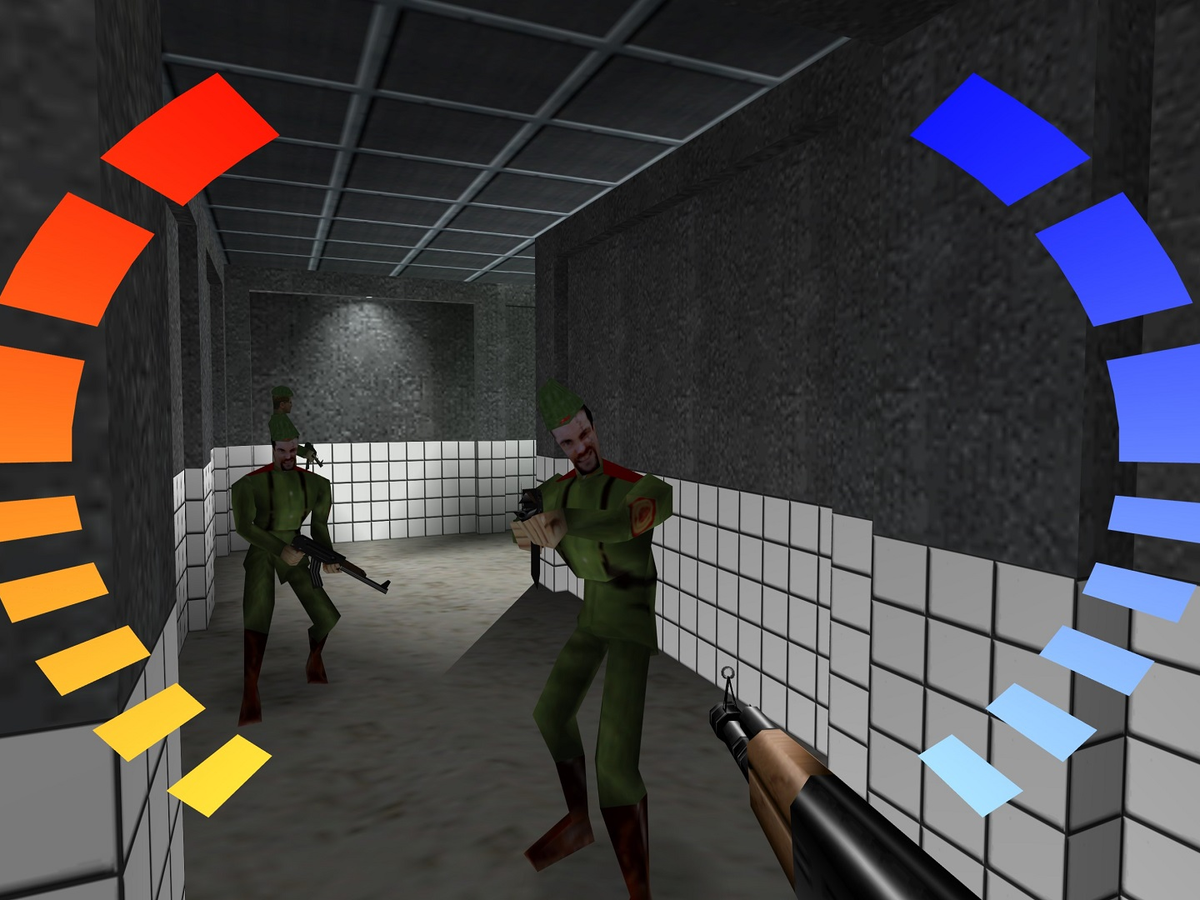
One of my disappointments when receiving my first whole game experience was the lack of cutscenes. Having little memory of the game's visuals back when I played snippets of the game and not so much as looking for clips of it on YouTube, I assumed the cutscenes would be similar to The World is Not Enough for the N64 (clips I did stumble upon). It is not perfect in graphic or audio quality, but at the very least, it is somewhat cinematic. At first, the game seemed that way with the Gunbarrel sequence; however, when I played the first mission, aside from a view of the dam and a description of the place and time, the level took me straight into the action. I thought maybe, in the second level, I would get a proper cutscene when I encounter Bond's friend (and soon-to-be foe) Alec Trevelyan. Instead, there was no cutscene, and both characters' dialogue was written in the text. And to make matters awkward, though I am not the type who gets too critical with graphics in video games, there was a bit of an uncanny valley seeing lifeless photographed faces (some horrifying to look at) attached to chunky pixelated bodies. In hindsight, I should not be too surprised, considering most N64 games I played were not too focused on having big cutscenes with spoken dialogue. But being spoiled with the later Bond games I've played (or looked at in the case of the next N64 Bond game) and hearing about how the game is a staple in video games that typically tops the other 007 games, I was underwhelmed. 

Despite the graphics and cutscenes not meeting my expectations, there was still a charm and appreciation for how the game told its story. Given how little the game relies on cutscenes, players are provided with dossiers from MI6 before playing the level. The first is a non-diegetic summary of the mission; the second is M instructing Bond what to do; the third is Q with instructions on using a gadget; and the fourth is a few words from Miss Moneypenny. While reading the briefings, I used my imagination a little and felt like I was in Bond's shoes. I love watching cutscenes of Bond gaining information, but it always felt like I was watching a movie. And while I can't say the game's form of briefings is my favorite since I believe games like The World is Not Enough and From Russia with Love are handled better, reading the files does feel personal. I can almost hear the annoyance in Q's voice when telling me to be careful of his equipment or picture Miss Moneypenny flirting with me with her unhelpful teasing comments while reading the briefings. 

Further selling the immersion in the confines of the game's limitations, though the dialogue exchanges are in written text during the gameplay, as many games would pause all the action and have the player read and click on the subsequent text, the game does not stop the player from moving about. When Bond first meets Trevelyan in the game, a player does not have to stare at a pixelated face awkwardly. They can set up the bombs while chatting with him. Later in the game, after Bond catches up with the villains on the train, though dialogue is present, the player is allowed to make their move with killing General Ourumov to rescue Natalya at any time, allowing the player to feel the suspense of the situation of when to act as Bond. Depending on how a player plays can also affect the outcome of a character meeting. One could listen to the interrogation and make their move when a guard comes in or picks up a gun lying right in front of a player and starts shooting to get out of there fast. When discovering that the head of Janus is Trevelyan, Alec's dialogue will alternate if you are carrying a gun or concealing it. After finding the truth, a player could read Alec's reason for his betrayal or start firing away. I always get excited watching the cutscenes in the later Bond games, but still controlling Bond during his meeting with the characters and altering how they happen in the midst without failing the mission is an absolute rarity in the franchise that makes the events more engaging. 

The actual few cutscenes in the game serve as bookends to the mission. The mission would start with an establishing shot of the location (with a title card at the bottom), the camera sweeping to the back of Bond's head, and the image dissolving to his perspective and ending with Bond exiting. That's all there is to those cutscenes, though I have to admit, as simple as they appear, there is something extraordinary about them. Part of that is because the establishing shot is not always the same image. Each time a level begins, the first shot happens in either a different room or a section, creating a more spontaneous beginning. The beginning of each mission is not the only time the game changes images or shows something from a different angle. In the very beginning, after the gun barrel sequence, the order of characters that would appear in the opening credits would be the same. However, they would appear from an alternate shot, sometimes with a different attire and weapon, adding more personality and style to the opening. My favorite alternate cutscene has to be during the showdown between Alec and Bond at the bottom of the satellite antenna. If Bond manages to shoot Trevelyan off the antenna, a cutscene would show him perish to his death. However, suppose Bond falls off? In that case, a cut scene of Bond falling will take Trevelyan's place, which I think is astonishing that the developers went out of their way to animate a dark alternate ending to bring a heavier sense of dread for failing instead using the same game over screen.

The cutscene for showing Bond on-screen would not alternate; however, it perfectly fulfills the purpose of placing the player through Bond's eyes by literally doing so. Agent Under Fire tried to recapture the feeling of going through Bond's head to see through his eyes. However, given the game's advanced appearance by looking a little more realistic, zooming through Bond's back head and watch his eyes vanish look glitchy and awkward. The PS3 version of Quantum of Solace was seamless, switching back and forth from third-person to first-person, but it does not use the transportive camera work Goldeneye uses. Sometimes in Goldeneye, the camera would sweep through the level long before revealing Bond, showing more of the location while building up to the hero's model. In a way, the imagery and camera work almost feel spiritual, making the player feel like a spirit wandering through the game and possessing Bond where his fate is now in your hands.

The Bond model may not talk or perform much action, but the programmers do everything they can to make him stand out whenever his image is shown. It's neat to see Bond in various clothing, whether wearing a stealth suit, snowsuit, business attire, or tux, and wielding the weapon of a player's choice. Bond's body language outshines those elements, though. Despite not much happening in the cutscenes during the finale of a mission, it feels rewarding to see Bond act confident and calm without any words or facial expressions. Watching him casually walk away from an explosion, adjusting his tie, posing with his gun, jumping off a dam, or casually folding his arms when captured brings a strong sense of accomplishment for finishing the mission the way Bond would have. I mean, the game has the most extended make-out scene in all of Bond history, which fills up the entire credit time, allowing the player to really enjoy the romance after saving the world. The only time Bond is ever shown firing his gun during a cutscene past the opening sequence depends on whether you shoot the guards when entering a train, a nice little easter egg I discovered during my recent playthrough. 

As an adaptation of the movie, the game does a near-solid job of following the events. All of the big action scenes from the film are present, such as the pre-title sequence, Bond driving a tank, Bond and Xenia fighting in the jungle, and the showdown on top of Trevelyan's satellite antenna. And the many liberties the game does have are mainly called for. Bond has to rescue Natyla from an exploding helicopter instead of getting trapped and escaping with her to create an interactive experience. Bond hops aboard Trevelyan's train without using a tank to derail it and fights guards from car to car. And players can dispatch the henchwoman Xenia Onatopp by killing her with their weapon of choice since animating her elaborate death would be nearly impossible. To make the players feel like they were playing in the movie, the developers visited some of the sets, took photos and videos, and acquired the set's blueprints and pictures from the costume department. 

One of my favorite alterations to the source material that this game does best is how it expands on scenes and ideas from the movie. In the movie's opening, Bond is already on top of the dam, making his way to bungee jump. Incidentally, the sequence with Bond getting ready to bungee jump in the movie was supposed to be longer by showing him activate the electric gate while sneaking past guards; however, it was cut for time. Though the first level of the game takes place at the dam, players must fight past guards and unlock gates to make it to the part of the area where Bond bungee jumps, much like in the deleted scene, just with gunplay. Places where Bond was only present for a few minutes or has never been in the film are made into action-packed levels. The Frigate in the movie, which Bond was only on for less than a minute, failing to stop Xenia and Ourumov from stealing a Eurocopter Tiger attack helicopter during a public ceremony, is now filled with terrorists who are holding people hostage who Bond must rescue on his way to the helicopter. The Severnaya Bunker, which Bond has never visited in the film, becomes where he meets Natalya and witnesses the first time the Goldeneye satellite is in action as the two escape. And for the many levels based on scenes or locations from the movie, there are a few levels made up by the developers. One of the most innovative levels is The Caverns in Trevelyan's secret lair, where all the water drains to when the giant satellite dish surfaces, with a color scheme of cool colors and futuristic doors that Karl Stromberg or Dr. No would love to have in their secret lair. 

Of all the liberties the game takes with the story, the most original of the changes is having missions building up to the present-day events. Since Trevelyan's fake death happened nine years ago before Bond encounters Xenia, the game has three levels of new material between these events. Bond visits the Severnaya Bunker, where he makes a copy of the Goldeneye key and meets the backstabbing computer hacker Boris and has a brief encounter with Ourumov at a missile silo after taking a photo of the Goldeneye satellite before getting launched into space. It is plausible for Bond to have other missions between events, especially when relating to Ourumov, given their rivalry. However, from a storytelling standpoint, nothing is added, and it makes no sense (think of all the trouble Bond would have saved if he had destroyed the satellite instead of taking pictures of it). But as pointless as these levels are, they are still fun detours filled with incredible action and objectives, providing players with a visual look at the Goldeneye and some fun character moments. 

Like Bond, though the characters in the game are silent and blocky, the written dialogue, movement, and actions give them distinct personalities. Many of the characters are accurate to their film counterparts. The sinister Trevelyan is as challenging and quick as Bond, Ourumov is a cold threat, Boris is comical, and Zukovsky is a helpful ally if it relates to his best interests. Outside of the MI6 regulars, the only main supporting character who does not physically appear is CIA agent Jack Wade due to rights issues. Unfortunately, the only real shortcomings in the game's portrayal of characters are female characters. Xenia, one of the greatest henchpersons in the franchise, is reduced to a minor role in the game. Before Bond has a boss battle against her, she is only seen at the train level, where she stands there with Ourumov and Trevelyan with a captured Natalya. At one point, the game says Xenia would be on the Frigate, which would be a perfect level to introduce her, except she never appears. And for levels that could show her and Bond facing each other, either at the Bunker or perhaps him chasing her and fighting off goons at the Turkish bath to get her to escort him to Statue Park, she spends more time on the dossiers than in the game (a problem the game Goldeneye: Reloaded would fix). 

To give Xenia credit, as a boss, she is as skilled and taunting as she is in the film, while with Natalya, she is easily the poorest adapted character in the game. When people mention her name in the movie, she is typically considered one of the best Bond girls in the franchise. However, when mentioning her name to the gaming community, she is considered the most frustrating part of the game. Now granted, there are a few strengths the game gives her. Natalya is still skilled at computers, and when giving her a firearm, she is actually helpful when fighting alongside her in the jungle. I was surprised by how good she is at killing guards, hardly ever taking a bullet from them. And like Winston the Butler in Tomb Raider, if you leave Natalya locked up, she won't be a hassle to complete objectives. That's probably why I hardly had a problem with her, unlike other gamers, because I usually escort her when I'm done with all the objectives, which is easier than bringing her along. And that's the problem when comparing her character to the film; Natalya should not be an issue to have. She was not a skilled agent and was vulnerable on many occasions, but she was brave, challenging, and resourceful to stay alive as she hardly took any crap from the other characters. But in this game, she acts like a frightened, confused child without her gun and hacking skills. When fighting enemies, she'll get in the way, resulting in her getting shot. When she does not have the sense to stand in the line of fire, she'll run away and hide, forcing the player to search around for her, that is, if she does not get shot by a guard. 

After all the trouble of protecting her, she has the nerve to act like she is behaving as badass as Bond was when all she does is run and hide and suddenly get captured in the next mission. But that's not half of what's wrong with Natalya. When protecting her from enemy fire while hacking the Goldeneye satellite, she'll tell you to quiet things down. I'm out there risking my neck for her AGAIN; loud noises should be the least of her worries! And if I kill Boris, she'll refuse to save Britain. I can understand the game itself claiming Boris is a civilian causality for not having a gun, but for Natalya to be willing to let people suffer because of my action with a man who attempts to kill me makes her a whiny, self-centered brat. The game did Natayla dirty. For a character who could be one of the best Bond girls in the game franchise, it is as much of a step backward as Nicole in Blood Stone. And the fact that this game has one mission proving she could be as awesome of a character as she is in the movie makes it all the more of a letdown. 

I have said this a lot about 007 games in general, but especially regarding this game: the story is not why this game is fondly remembered. It is fascinating that it was not meant to be a first-person shooter during the game's early stages. At first, it was considered a side-scrolling platform game for the Super Nintendo until the developers thought the game should be made for the N64 for its 3D quality graphics. Unsure of what the console was capable of, the concept was changed from a side-scrolling platform to an on-rails shooting. Due to delays and the popularity of the Doom game series, which spawned off plenty of first-person shooting clones, the on-rails shooting platform was dropped to follow the trend. There was still a significant risk when creating the game, which was designing the first shooter game for a console system, as they were not well received then. Thanks to the game's smooth controls, imagination, and freedom, gamers and critics realized a console first-person shooter for a movie tie-in can become legendary in gaming. 

Obviously, without the success of this game, there would most likely be no Agent Under Fire, Nightfire, or The World is Not Enough, considering that is where the gameplay in the franchise originated. Players can choose to use stealth or go in all guns blazin', use gadgets, and fight against Bond villains. However, considering that Bond games after could give gamers so many other things to do, this game is still hailed by many as the definitive Bond game. And taking away how it would influence the franchise and first-person shooter console games, why is it typically considered the strongest? 

As fun and improved as most Bond games are, the secret to the game's success is how much it challenges the player to think like Bond. The games that followed afterward had voice acting, vehicles to drive, more substantial graphics, and storytelling that felt cinematic, with Bond doing cooler stuff in the cutscenes. On that basis, they should feel like the ultimate Bond experience, and while certainly looking like it and playing it (even rewarding the player for thinking like Bond), there seems to be something missing. Perhaps it's because I usually play these games on the easy difficulty, but while they can be challenging, they feel like they're holding the player's hand for most of the part. The games, as action-packed and badass as they are, usually tell a player what to do, even without hearing the allies instructing you during the mission. It's typically clear where to go, what to do, and what methods seem appropriate. Even during the on-rails and driving missions, figuring out what to do or surviving was hardly much of a challenge. The times I can think of getting stuck on a level in the games after Goldeneye for its unclarity was either using a Q Decryptor in Nightfire, unsure what gadget to use to stop a van in Agent Under Fire, and not figuring out the weakness to forklifts in 007 Racing

Goldeneye, though a first-person shooter, functions more as a puzzle game than just shooting enemies to reach the next objective. There are certain levels where a player must think carefully if firing around or sneaking past guards is the best choice. Usually, it depends on the size of the levels. If it is outside on a wide-open landscape, fighting against guards, head-on is practically inevitable. With an emulator, it should be easier to playthings stealthy in these environments, but as someone using an N64 hooked up to a modern TV, the enemies from afar can be as hard to spot as they are in Tomorrow Never Dies or The City of Walkways in N64's The World is Not Enough. Sometimes, the guards blend into the background, while on other occasions, they're already shooting at me before I can see them. It's usually when a player is inside a tighter environment, whether The Bunker, The Facility, or The Archives, where stealth is encouraged. A player can see the guards better, making it more advantageous than others. But the catch is that once guards are alert, they'll keep spawning in herds, making it easier for players to find themselves cornered and die. And it's not just avoiding guards catching you if you encounter one; it's also preventing the security cameras and drone guns from seeing you. 

As small as many interior levels are where one must be cautious and observant, the more expansive levels require a player to act the same, even when stealth is not an option. Many of these levels are like mazes, causing players to get lost in the fog or familiar rooms where one must rely on landmarks to navigate. When given a task to use a gadget, destroy a piece of equipment, or collect items, though the game gives players an idea of what to do, it never tells you how to do it efficiently. A player cannot hear M or Q instructing Bond where to go, how far they are completing their task, or where to install their devices; they only have the briefings to reference and resources. It's a game all about trial and error to know what to do. There's also rarely any particular order of finishing an objective, meaning the player can perform them anytime like as long as they are completed, just like what Bond would do. And unlike how most games would lead to a mission failure for failing a task and end, this game allows you to keep playing because that's what Bond would be realistically doing, carrying on with his mission. A player just won't see a cutscene and progress to the next level. 

While challenging the player's thinking during a mission, the game's action when battling enemies is explosive. What I always loved about playing the 007 games on the N64 was having a controller with a trigger, which always made the feeling of firing at enemies authentic. Adding to the sense of realism is how enemies respond when you shoot them. In most games, they die instantly or feel invincible until they suddenly drop. In this game, they would slow down and react to their bullet wounds when you shoot them. The guards don't have the same reaction and speed when they get hit; it varies to fit the situation appropriately. And unlike how most Bond games don't show blood when a guard gets shot, this game is one of the few to show it. For me, to say the way the enemies die, and scream is fully realistic is untrue because their screams and the way they collapse or fly away from an explosion are highly exaggerated. But these little details to show the guards suffering from your gunfire are enough to make their deaths feel more impactful than usual. 

Conversely, feeling danger while sneaking around or fighting against enemies is always present. Of course, that is a given in all the 007 video games, but no matter your difficulty, getting hit by any enemy takes away your health and does not slow you down. Goldeneye ensures you must avoid enemy fire at all costs for two significant reasons. The player is given two color-coded bars; the orange is how much health they have, and the blue is how much armor protects them. In most games, when a player loses health, the body armor they pick up can increase their health. Goldeneye raises those stakes where losing a part of your health means there's no way to rejuvenate it. The only hope is to collect as much body armor as possible if one is lucky to find it. And if a player gets shot, rather than fighting forward as if you were never hit, a flash of light appears, causing Bond to breathe heavily and push him back a bit. Although a player can't feel it, the sense of pain because of the impact keeps them on their toes, especially when knowing how much to lose. And the guards, though, are weak when shot, have the power to act as skilled as the player is by hopping around, kneeling, and using weapons as powerful as yours. When the player gets killed, blood trickles down on the screen like in the gun barrel sequence, which would become a staple in the game over screens for many Bond games. The game even shows cutscenes of you dying from the spot you were standing from different angles, which I would say adds insult to injury, but it can also be helpful for a player to be aware of where enemies are coming from for a replay. 

With many Bond games, when changing, the difficulty usually leads to the same objective, only with stronger enemies and limited ammo and health supply. Goldeneye offers the same challenges, except players are given new things to do depending on the difficulty. For instance, in the first level of the easiest setting, all I have to do is make it to the end of the level. But on the hardest difficulty, I have to neutralize all alarms and use some of Q's gadgets. And the game is hardly ever short of giving players new things to do for the difficulty they choose to play. Players must destroy security equipment, defuse bombs, make it out of a level on a time limit, use more of Q's gadgets, rescue more hostages, and rendezvous with some of the characters. As frustrating as the difficulties can be, the excitement and interest remain for the game, giving a player plenty to do than just survive, adding to the replay value. The only thing that gets confusing about the concept is reading the dossiers. No matter what difficulty a player chooses, all the dossiers read the same, meaning M and Q will give the player the exact instructions on the easy setting as if a player decided to choose the harder setting. However, all the player has to do is follow the bullet point objectives, which certainly helps, but it makes reading through the dossiers almost pointless aside from a storytelling standpoint. 

Increasing the difficulty with new objectives gives the game a special flare that's barely seen in other Bond games, but what makes the game so unique and one-of-a-kind is how much freedom it offers. Since the game does not kick a player out when they fail a mission unless they are killed, the levels can function as sandbox gameplay. Players can kill as many civilians as they want, explore every nook and cranny of a level, countlessly fight off many guards until death or boredom, and cause countless explosions. And I am not talking by just shooting explosives or using them; I mean almost everything in the game, even a model plane, can explode and cause a chain reaction. Compared to the others that follow, how much the game encourages a player to play through a level as long or short as they want is a rare privilege. 

Naturally, the selection of weapons, like any Bond game, plays a significant part in making the gameplay action so amusing, and the game offers some of the best weapons in the franchise. Aside from the infamous Klobb, the machine guns are powerful and typically have good accuracy. My personal favorites are the heavier set, including the US AR33 Assault Rifle, and the weapon Xenia carries, the RC-P90, which is easily the best machine gun. As always, players are equipped with Bond's signature weapon, the PP7 Special Issue. However, my favorite pistol easily goes to Ourumov's weapon of choice, the DD44 Dostovei, for its impactful sound design and the damage it causes. When holding a sniper rifle, unfortunately, a player cannot see through the scope but can zoom in and out when aiming toward enemies to make up for not having animation to simulate looking through one. The sniper rifle is also the only weapon where a player can kill enemies by using the butt of the gun, adding more variety to using the weapon, which is barely used in Bond games before the Craig era. The game even contains a rare combat weapon, a throwing knife, that hardly works but is more than satisfying when penetrating an enemy. The best weapon in the game that is more powerful than an explosive is the Golden Gun, which players love to collect in multiplayer mode. But on top of everything, the best part of using weapons in the game is being able to carry dual weapons, which means a player can fire two pistols, two shotguns, two machine guns, and even two explosives at once, doubling the amount of destruction for the fun or challenge of it.

Just as the game cannot get any more generous with its freedoms, the cheats spoil the players. Cheats are usually accomplished through speed runs. The very reason why the mission The Runaway is short is to practically hand the player their first cheat, to let them know they can unlock them depending on how fast a mission can be accomplished. That also includes performing missions fast on different difficulties. I could unlock a few; however, I had little to no luck accomplishing as much as I had to. Luckily, I heard there's a way to unlock cheats without working for them, and thanks to the internet, I could use them all. Whether playing for them or using cheats to unlock the cheats (as odd as that sounds), they are indeed really worth it. Some make the experience cool and comical at the same time, such as paintball mode (where beautiful paintball colors replace bullet holes), D.K. mode (giving the models large heads and arms like Donkey Kong), and Tiny Bond (where everything is humongous). Suppose one wants to feel as "invincible" as Boris. In that case, one can become invisible, carry all guns with unlimited ammo, take no damage, or use all the cheats to become unstoppable. Using them all for the first time certainly helped me alter the story a bit, like killing Trevelyan earlier in the game and still completing a mission or rescuing hostages undetected as the guards cower. You can also bet the game won't be short by supplying players with new weapons, like a hunting knife, a Cougar Magnum, and a stunner made to look like a Gameboy. On top of it, when completing all difficulties, the game allows a mode named after Bond's number that can edit enemies' health, damage, speed, and accuracy, who can either be the weakest foes ever or unstoppable sharpshooters. 

All of these cheats are marvelous and incredibly useful, but the best unlockable of them all are the secret levels. The way to unlock them is by finishing all three difficulties, and before I found a way to use the cheats while playing the game and still allow myself to move on to the next level, I nearly gave up. I must have test-played at least 6 Goldeneye copies at my local game store to see if I could access the already unlocked secret levels, only to be disappointed to find none. As I have stated, I am not a serious gamer; therefore, as much as it hurts that I would most likely never play these levels, I would still report on them by watching videos. But through the miracle of the internet, I managed to play the secret levels, and my experience did not disappoint. From Russia With Love, Goldeneye: Reloaded, and Everything or Nothing contained secret levels, except they were ordinary. Nothing special happened in terms of story or objective, making them bland and uninteresting. As much as I love the secret racing level in Nightfire, it is still just a racing level. Goldeneye could have been like the following games; except they treat these missions as part of the game's story mode. Both missions are based on films from the Roger Moore era. The first mission, Aztec, is based on Moonraker, with a tuxedo Bond sneaking into a beautiful recreation of Hugo Drax's secret launch pad, fighting off guards and Jaws with a laser gun while finding launch codes and escaping from the blast of a rocket that's about to launch. The second mission, Egyptian, is the most original as it combines a few films. It involves Bond going through a Spy Who Loved Me-inspired Egyptian setting with the mission to acquire the deceased Francisco Scaramanga's golden gun while avoiding a booby trap and fighting against a laughing and unkillable Baron Samedi. Both levels pay a wonderful loving homage to previous Bond films through their choice of villains, eye-appealing level designs, creative new objectives, and stories reminiscing Bond's adventures.

Because I have fewer limitations and less help with finishing a level, I feel more like Bond and am rewarded when succeeding (And I don't need the game telling me every time I perform a Bond move as I play). And the fact that I can do whatever I want when toying around with a mission certainly hardly gets boring. With that said, and once again, coming from someone who is not a hardcore gamer, that does not mean the game cannot be unreasonably complicated. It's incredible that the game wants you to strategize and get to know your surroundings, but it gets annoying when you repeatedly stumble upon the same landmark. Trying to figure out how to complete a task efficiently can get so frustrating and confusing that one would need to rely on a YouTube Let's Play video to understand what to do (which I certainly had to). And unless you use cheats or have all the time in the world to know every level inside and out and have been practicing your aiming at a harder difficulty, you'll find yourself dying over and over and over until you can't take it anymore. Even the secret missions are incredibly hard as well. I suppose that's expected, given how they are traditionally unlocked by completing all difficulties, but even in easy mode, these missions are frustrating to finish. Just as I used cheats to unlock these levels, I still felt the need to do the same to finish them. I highly appreciate and admire the game's difficulty for a player to earn cheats and feel like the hero, especially since it has hardly been recaptured in future Bond games. But the sheer frustration of trying to figure everything out while at the risk of dying does distract a bit from the amusement factor. 

The gadgets in the game are half and half. Some of the franchise's best include a watch with a laser and magnetic setting, a tracking bug, and (my favorite) the remote bombs. All the items I mentioned are delightful; however, all the other equipment just exists. Aside from seeing them on Bond's watch, they never appear physically or that interesting. They mainly serve as generic hacking equipment. Bond also has a Moonraker-inspired mini-camera, which I was interested in seeing in Bond's hand, only to discover that the camera is as invisible as the one in Agent Under Fire. While the watch is cool and needed, a part of me is annoyed that the laser is not rechargeable. So, when using all its power to escape from the train or kill a guard it becomes useless. The watch's restrictions add to the suspense, and I can use cheats to make it unlimited, but it's still an annoying limitation. These gadgets were excellent for the time, and in some respects still are. However, compared to later games, not many of them have stood the test of time, though they certainly are better than most of the gadgets in the Craig era. 

What I am about to say may be the most sacrilegious thing anyone can say. It could be something that will lead gamers and Bond fans to feed me to the piranhas, but I have to be honest: the multiplayer has not aged well. Before I lose creditability for this, let me clarify that it's not bad and should still be celebrated after all these years! Understanding that I barely have nostalgia for the multiplayer experience, I acknowledge and appreciate how this multiplayer paved the way for so many other console multiplayers involving firearms. And having experienced the multiplayer mode a few times since I received my copy of my game, plenty holds up about it: the weapon selection, the character skins, the cheats, and many of the maps. My best memories of playing it are going to The Facility and trying to access the Golden Gun. And unlike many people who say Oddjob is forbidden, I allow first-time players a chance to play as him, adding to the challenge while they get comfortable with the controls. 

In essence, especially when discussing Bond games, we owe a lot to Goldeneye's multiplayer campaign, but compared to the games that followed, I rarely play it. It amazes me how much of the game's story mode holds up where I can do so much and revisit the levels just to mess about, while I feel I can only do less with multiplayer. Considering how most maps function as mazes requiring four players to keep the action going, as someone who does not usually have four people visit, it's annoying that I am limited to a few smaller levels to have a proper match. After Goldeneye, 007 games that can still allow four players, typically accommodated for gamers who only had two, mainly by the maps, or including A.I. Bots to fill in the void. While many of the maps in Goldeneye are based on levels from the game, they feel empty and have little personality, which is not as engaging to play around as other Bond games. It's also disappointing that every level starts with a player unarmed, rather than being supplied with a weapon, which one could argue is part of the fun, but personally (and I know I am not alone on this), I want my gun right away as I find better ones so I can get the action started. The character skins are still neat, but so many of them are guards and civilians that there are very few special characters worth playing as. Part of that is because the developers wanted to lower the number of women characters since it would be in bad taste for Bond to shoot women (a rule I hardly understood, as I mentioned in the past). It has been reported that the multiplayer was made at the last minute, and I can see why. Make no mistake, what they did was beyond incredible; it is downright historical. However, living in a post-Goldeneye 64 world with multiplayer games that not only have more time but offer so much more in terms of personality, skins, gadgets, weapons, and accommodations, of all the best multiplayer Bond games, Goldeneye 64 is the one I revisit the least. 

On a more positive note, the game does have the catchiest score. Now, many Bond games afterward had incredible scores that sound cinematic, giving the games a ton of atmosphere. Though working as a score should function, when I think back to scores in Bond games, I think about the music in this game the most. I feel excited and relaxed when I hear softer versions of the Bond theme when reading the dossiers or looking at my watch. The elevator music playing the Bond theme is a tuneful rendition I can hardly ever get tired of. The music for The Dam is loud and exhilarating, while the music for The Facility is eerie and industrial. Fighting my way through The Silo has catchy electronic music with a tempo and melody that comes across as urgent. When exploring Statue Park, I get goosebumps when hearing patriotic music that sounds grim and ominous. And the score when chasing Trevelyan on The Cradle increases the tension and excitement for this showdown. The only nitpick I can think of is how the Bond theme is overused, which hardly bothered me considering the different styles in which the theme is played, which are groovy and perfectly fitting for the location and scenario.

I cannot stress enough how difficult it was to choose between Goldeneye and Nightfire as my favorite Bond game. Nightfire came at a close second, and as important, nostalgic, fun, and dear the game is to me, I can't deny that Goldeneye is my favorite and, overall, the best game. Sure, it's not cinematic. Yes, the driving level is not too different from when shooting on foot. The on-rails shooting is not present. I won't deny it's the most complex Bond game I've played. And the gadgets and multiplayer certainly have not aged the greatest. But my goodness, is it still a thrill to play! The game has a ton of historical merit in gaming, which should not go unnoticed, and remains as one of the greatest video games of all time. It is even one of the greatest movie-licensed games of all time because it respects the source material and knows when it's appropriate to take liberties. And when judging strictly by its gameplay, it's the best of all the Bond games. As frustrating as the missions and puzzles can be, I'm still having the time of my life using various weapons while encountering numerous guards and blasting them away in over-the-top violent ways. Beyond that, what makes the game so amusing and the most unique of the Bond games is the number of freedoms this game offers. A player can practically do anything; adding cheats to the equation only enhances the experience. With Nightfire, though I always enjoy myself, I know what to expect, while with Goldeneye, I'm never usually sure what will happen. Every time I turn on Goldeneye, it is a different experience based on how I play the game, making it a more interactive and spontaneous experience. Coming from someone who rarely played Goldeneye as a kid, I'll always appreciate and hold sentimental value for the Bond games I favor on this list. However, I have to admit that Goldeneye is still the superior Bond game, even if I put the game's historical impact and my nostalgia for other games aside.  

                                 Least Favorite Mission: The Train Depot

I was close to choosing one of The Surface missions for its empty, foggy winter landscape, but as lost as I found myself in the level, I remembered more exciting things happening there than in The Train Depot. This level's only real purpose is having the player get onto Trevelyan's train. There are alternate things to do, like destroy the computer network and obtain helicopter plans, but nothing happens. Aside from having a weapons room and meeting room, the level is boring with its many empty warehouses. There is no encounter with the characters to make things engaging from a story perspective. And the objectives are very standard. As hard as many of the other levels are, there was something worth playing for when here, from what could be summarized in a mission briefing, we get the most pointless level in the game.

                                         Favorite Mission: The Facility

Apart from being my favorite multiplayer map, The Facility mission is the strongest from a storytelling and gameplay standpoint. Players get to engage in key scenes from the movie, like killing the guard on the toilet, meeting Trevelyan and witnessing his fake death from Ourumov, setting the explosives, and escaping on a conveyor belt. All the key moments are there, yet the level still has plenty of things to do. More soldiers are hidden in the bathroom stalls to fight, keys must be collected from guards or double agent scientists (one modeled and named after one of the game developers, David Doak), and players have to escape from poisonous gas. This is also my favorite level to mess around with the cheats, as all sorts of strange things happen. If you shoot Trevelyan when meeting him, he'll comment on your betrayal and try to kill you. If you kill Ourumov before he shoots Trevelyan, Trevelyan will stay frozen in the spot where you can kill him and still pass the mission. However, if one wishes to chase Ourumov, he will make it to the start of the level before disappearing. And if you're a psycho like me, wanting to explore and destroy everything and everyone in plain sight (including scientists), there are tons of opportunities. I don't even need to use the remote bombs to destroy the factory; I can just shoot at the tanks and blow up the guards with the bombs instead. This is my go-to level whenever I decide to replay the game after a long period and just want to have fun exploring and causing unwanted destruction. And when replaying the entirety of the story mode, this is the level that gets me sucked into the story and hyped to play more.

Tuesday, December 31, 2024

007 Game Rankings: Number 2: Nightfire (Ps2, GameCube)

As a kid, I received a promotional DVD for GameCube games to be released in 2002. Having played a bit of The World is Not Enough for the Ps1 and Agent Under Fire, I had no idea another Bond game was in the works. When I saw Bond introducing himself in the trailer through his iconic line, I gasped in excitement to discover that a new Bond game was about to come out! The trailer played to the tune of the classic Bond theme, starting as slow and edgy as the first half of the score, showing Bond sneaking around with new gadgets, introducing the new Bond Girls, one of the driving missions, and guards preparing a sneak attack. After the later image, throughout the rest of the preview until the finale, Bond and the guards fire at each other left and right, along with explosions as the music becomes loud and dramatic. By watching the preview, I went from being interested in the game to anxiously wanting to play when the action kicked in. What convinced me to play it as soon as it was released was the final image with Bond in Space, no doubt serving as the game's climax. I was not a big sci-fi fan, but I was curious to see the game occur in outer space. I was craving to play as Bond in outer space, along with all the other cool new features and locations I wish were in Agent Under Fire

When convincing my parents to buy the game, despite owning Agent Under Fire, they denied my request because of its violence. My desire remained and only increased when I saw it promoted on my GameCube box and saw a new trailer in the game section at Toys R Us in New York City. When finding it available on sale, my mom bought me the game, and for a very, very long period, it became my addiction. Despite getting stuck in the Night Shift mission for not knowing how to use one of the gadgets until my brother Jesse figured it out, I would revisit the story mode and play multiplayer with my brothers for endless hours. The game had everything I desired in a Bond game, living up to my expectations. And after all these years, the game holds up extraordinarily well! And please remember, I'm only covering 007 games for the PlayStation and Nintendo consoles, which means there won't be a part two for me to explain the PC version. 

Not since Goldeneye had a Bond game opened with an animated gun barrel sequence. As the only two Bond games I played then, The World is Not Enough for the PS1 used footage from the film, and Agent Under Fire did not even bother. Seeing EA finally create a gun barrel sequence to start the game excited me, giving me the feeling that this game is about to be the ultimate Bond experience. And in the first mission, which served as a tutorial, the game had already been outdone itself in under ten minutes. The mission's set in Paris during New Year's Eve (where apparently people are tossing confetti before it is time) where I am tasked to use various game mechanics such as on-rails shooting for the first half and driving the Aston Martin Vanquished for the second half as the level is showered with action, explosions, and humor. There is also a lovely Bond Girl for Bond to escort and rescue and a short appearance from Q aiding our favorite spy in his mission. This first mission even has elements that Agent Under Fire lacked or did not do including having the Bond model with Brosnan's likeness, proper delivery of Bond's iconic introductory line, and Bond about to make love. 

After the mission, the game has an opening credits sequence, with cinematic visuals like the Bond Girls that would later appear, images from outer space, and flames, along with a fire color palette. Instead of the visuals moving to an instrumental, it is an original song by Esthero entitled Nearly Civilized that is energetic and seductive. I have criticized this sequence for not having any credits aside from the title and the song not tying into the story. However, to have an opening credits sequence explicitly designed for a Bond game was unseen. The closest the games ever came to having one was showing footage of the opening credits from Tomorrow Never Dies, just with new credits connected to the game. To see a movie-style credits sequence while discovering the mission I just played is supposed to function as a pre-title mission, along with all the goodies the mission has, was a fantastic surprise that made me hope the rest of the game is as spectacular as everything I just witnessed. I still think the pre-title mission in From Russia With Love is the best (even if it lazily uses film footage of the gun barrel). However, this mission did bring the game franchise in a different direction that was mind-blowing for the time. And the best part is, in terms of gameplay, this mission can be played again without the tutorial features, which makes it more interesting than having it hold your hand every time a player revisits it. 

During my Everything or Nothing post, I talked about the history of EA using Brosnan's likeness for the games and how this game uses his image but does not have the proper voice. Though his voice sounded weird at times when I was a kid, I did not think too much of it. Replaying the game in recent years and becoming familiar with the franchise is distracting. There have been many good impersonations of Brosnan, but he sounds a bit gruffer here. While Brosnan's voice and likeness would be more authentic in the next game, out of all Bond games, this is the game where Bond has the most personality. As much as I love hearing Brosnan and Daniel Craig's voices in the later games, they sound like they are reading their lines in a studio most of the time. In the From Russia With Love game, Sean Connery brings plenty of spirit and depth to his character despite sounding old, but his model is not as expressive as his voice. And the Bond in Agent Under Fire has an excellent design and has the characteristics of Bond, but Adam Blockwood's performance feels so phoned in half of the time that it's almost as if the character is constantly horny.

In this game, Bond perfectly balances everything we associate with the character. He is tough, cold, smooth, charming, funny, and empathetic, and even though Maxwell Caulfield sounds nothing like Brosnan, he nails down all the elements of the character. Sometimes, he can sound hammy, like when he asks two women for a ride after parachuting on top of their car as if Bond is trying to change his accent, but for the most part, he plays it straight. Caulfield sounds confident, sophisticated, and calculating, making him sound like a credible agent, and when making subtle dirty jokes and quips, while humorous, they are usually delivered cool and casually instead of feeling over the top or forced. I especially enjoy the subtlety when Caulfield expresses Bond's feelings towards the characters, whether showing concern for one's life or trying to deal with his emotions after losing a friend.

Further adding to Bond's personality is, of course, using Brosnan's likeness, which was motion captured by the respective actor, and years later, I am still impressed with how much expression the Bond model in this game has. Without any dialogue, there is plenty of personality to take away from the character, which is as subtle as Caulfield's voice work. The annoyed look on his face when given multiple tasks from a criminal he is assigned to protect, the look of satisfaction when taking revenge, and the brief look of puzzlement when spotting another agent, it is incredible how life-like and natural the expressions are. And as the cherry on top of all this, players can now finally play as Bond wearing a tux and a spacesuit, which you bet was another element that drew me into the game after seeing the trailer. As grand as it is to play in the next game with Brosnan's voice in the next game, as well as Connery's voice and likeness in the later game, I feel closer to feeling like Bond in this game, simply from the writing, graphics, voice work, and attire. 

Some of the MI6 regulars return in this game. M gives the briefings and hints to aid Bond, voiced by Oscar-nominated actress Samantha Eggar, bringing the class and demanding authority as Judi Dench does. The only nitpick is outside of standing in the shadows, M's physical appearance, like in Agent Under Fire, is never shown. It would have been intriguing to see Bond engage with her in a cutscene at MI6 headquarters, but her purpose in the game is fulfilled. When I discovered the character Q returned to the game franchise as a kid, I was happy to see him controlling the Aston Martin Vanquish, giving Bond gadgets, and looking annoyed at Bond's quips. If you read my Agent Under Fire review, you already know that my thoughts about his portrayal have changed, as I felt R in the previous game was closer to the character's spirit with a fantastic design. While the portrayal of Q in this game is not offensive and is voiced well, he comes off as pretty bland for his generic scientist design and sounding way too calm when he should be annoyed at Bond. R was proper but also aggressive, and there were moments in the games when he demonstrated his gadgets either passionately or mockingly. Yes, Q gets into the action a bit, but after that brief scene, he does nothing that stands out, not even in terms of personality. 

Another upgrade that this game has over Agent Under Fire are the Bond Girls. As many of them in the last game were underused or felt thrown in, here they all have personality and a purpose. The first agent Bond encounters is Dominique, a skilled driver and fighter, but her true strengths lie in her seductive charm of manipulating the game's main villain to gain inside information. Though Bond saves her at one point, she helps Bond by giving him a key to spy on a meeting and a parachute to escape from the building. Apart from aiding Bond, her personality is charming, supported by a sexy design and a beautiful French accent. She is also calculating and vulnerable, keeping her from appearing too perfect. Despite only happening in three levels, the chemistry she shares with Bond is believable and, at times, cute, coming across as a genuine partnership. Providing more layers to their relationship since Dominique is undercover, Bond sometimes questions where her loyalty lies, which is handled subtly. 

As a kid, I was hoping Dominque would be the game's main girl, only to be heartbroken to see her die a horrible death (which is still disturbing now). Unless the Bond Girl was connected to the villain, none died until this game. Paris lives in the Tomorrow Never Dies game (though she never appears again after the level), and Zoey Nightshade's death was a fake-out. In this game, Dominque does not survive the fall, nor does she and Bond have a final farewell; she is taken out quickly during a fight with another goon working for the main villain, making this the most shocking death in the game franchise. Within the same level, a blonde-haired Australian agent named Alura McCall (a pun on Lauren Bacall) rescues Bond, and the two become partners for the rest of the game. Of all the Bond girls in the game, I always found McCall to be the least interesting. She looks gorgeous, is witty, playful, a fantastic getaway driver and pilot, and technologically advanced. She has an upbeat and serious personality supported by an attractive Australian accent, making her one of the best girls in the game franchise. My problem is she feels shoehorned in as a last-minute replacement for Dominique. I suppose I wouldn't mind it so much if she weren't so perfect, making her a bit bland. If the chemistry she and Bond share was as engaging as the other characters in the game, that could make up for it. Unfortunately, their chemistry is nonexistent to the point where Bond does not seem too pleased to be partnering up with her, almost as much as the player who was emotionally invested in Bond's relationship with Dominique was. 

CIA Agent Zoey Nightshade from the previous game makes an appearance. I was not a fan of Nightshade in the prior game because of how bland of a character and voice performance she is. In Nightfire's case, she has improved in every single way imaginable. I had a hard time believing she was a CIA agent because of how incompetent she sounds, but here she is way more believable, coming across as confident and legitimately badass. None of the Bond Girls Bond meets in the game ever carry weapons in story mode, and Nightshade, who never had one herself in Agent Under Fire, is now firing at goons. As people think of Bond wearing a tuxedo while carrying a gun, Nightshade in a red party dress handling a weapon appears just as classy and rugged. While professional on the job, she has her fair share of jokey and flirty moments in the game, which feel as natural as Bond's, instead of unemotionally phoning them in. Everything about Nightshade in the game is smooth, beautiful, and dangerous, making her on par with Bond and her male CIA counterpart Felix Leiter. A part of me should be distracted by how different the character behaves and sounds, from how foreign she is to how she was portrayed previously. However, since the Bond franchise was hardly strong with continuity by recasting actors and giving them different appearances, even character traits, I can overlook Nightshade's change for how improved of a character she is.

Outside the Bond girls and MI6 characters, the only ally Bond meets during his adventure is Alexander Mayhew, who works with the game's main villain. Fearing that his boss will kill him for a setback, he asks for Bond's protection in exchange for evidence exposing the villain's scheme. The only time Mayhew and Bond ever meet, or team up is during one level, where he also dies. In a way, he reminds me of Mr. Henderson from You Only Live Twice. A British man living in Japan who has secret information to provide Bond, only to suddenly get assassinated during their encounter at his estate. Like Mr. Hendreson, despite not being a regular supporting character, he does leave a good impression due to his personality. Despite being a wealthy criminal, he is a humble middle-aged man who lives in fear and has a big heart for his servants. What makes their relationship so much fun, even if it is subtle, is how Mayhew pleads for Bond to do various tasks, which causes him to get annoyed to the point where he denies his last request. Mayhew's appearance may be the most short-lived of all the characters in the game, but not a second of character is wasted or pointless. 

In previous Bond games, I have talked about how underused the new main villains are. In Agent Under Fire, Malprave hardly appears nor has a showdown with Bond, and the villain in 007 Racing never appears and hardly says anything that I forgot his name as quickly as his motivation. Nightfire's main villain, Rafael Drake, makes up for all the previous shortcomings. Despite coming across as a blatant knock-off of Moonraker's villain Hugo Drax (having a famous, wealthy background, plan to dominate the world from space, and a goatee), Drake has a smooth, charismatic personality who shows no hesitance with killing people who get in his way. He is the kind of man who will invite you for dinner, refuse to give you anything, but instead have you watch the person you love die before killing you next. One moment, he's gracious, throwing a fancy dinner party; the next, he is scheming with his associates, threatening to kill one of his men who fails and sending a woman out to be tortured. While ruthless and sophisticated, his master plan is quite humorous. Not so much his master plan being executed from space, but more so that he plans to take over the world through his business after he blows up NATO bases. Afterward, a board of directors would replace governments (for instance). As silly as it is, it is funny how this man thinks less like Hitler compared to Drax and more so as a businessman with nuclear weapons. With an engaging two-faced villainous personality and a grand scheme, unlike the others, Bond gets to fight him in the final mission, who I'll admit is one the trickiest foes to fight in the games (which I'll get into detail later). Upon the original villain Bond fights in the games, Diavolo from Everything or Nothing is undoubtedly the best. Still, Drake set the ground rules of how an original Bond foe should presented in the games, and is undoubtedly one of the best, if not the most original. 

Drake's right-hand man, Rook, makes for a worthy foe for Bond to fight against, with each encounter they have having something important to flow the story rather than just having a pointless boss fight for the sake of one. Both characters are shown as Bond fires at a helicopter piloted by Rook, who plans to blow him and Nightshade to Kingdom Come, making him the first boss fight in the game. Just when you think he is dead, he is alive and well. However, later on in the game, when ordering his crew of snippers to kill Bond, we never get a full glimpse of his face. It is not until the second to last mission that Rook reveals his entire face, with the left looking as brutally scarred as Two-Face, as he wields a state-of-the-art laser gun to finish Bond. Rook has all the ingredients of a great Bond henchperson. He's strong, intimidating, and near unstoppable. And he has a distinctive look that, interestingly enough, was given to him by Bond, making the stakes a little higher given his vendetta against him. However, while having all the qualifications, his seeking vengeance against Bond is an afterthought, and his showdown with Bond, though a decent boss battle, hardly feels climatic. I expected Bond's final fight with Rook to be something big and challenging, which, to the PC version of the game's credit, delivers by having them fight in an anti-gravity astronaut training facility, where he dies by a giant blade. In the console version, Bond just walks around shooting Rook multiple times, dodging his laser beam until he dies, which is nothing special or unique. 

Of all the foes in the game working for Drake, the one who gets the most attention is the game's femme fatale, Kiko. Kiko serves as Mayhew's bodyguard in the first half of the game. She is pleasant and quiet yet assuredly skilled in her profession, and she aids Bond during his mission. As a kid playing the game, I did not suspect her to be the villain. Even when I saw that she was on the villain's side in multiplayer before seeing the twist for myself, I refused to believe it. But from the moment she shoots Bond with a tranquilizer dart to killing Dominque in the very next mission, I was both shocked and enraged, eagerly waiting to kill her more than Drake or Rook. During the boss fight, I was furious that I couldn't shoot her as she safely watched behind a bulletproof glass of Drake's goons firing at me while taunting me. When the time came for me to press a button, sending her to the blasted pit and see her fried to a crisp as Bond launched into space on a rocket, I laughed with glee that this two-faced assassin finally got what was coming to her. Looking back at Kiko now, it is easy to figure she is a twist villain, from her poor excuse of getting pinned down during a home invasion and suddenly disappearing after Bond retrieves the Nightfire evidence to reappearing out of nowhere. Whether Kiko's twist is obvious or not, she is still one of the best original baddies in the games for her manipulation skills, calculating and demanding mindset, having the heart of a cold-blooded killer, and having the best death in a Bond game. 

I don't usually talk about the typical guards that Bond fights in the game, but the game does something more with one of them than usual by making them a boss. Usually, in boss battles, guards assist the main villain or henchperson or fly in helicopters. In this game, the guard with whom Bond has a one-on-one boss fight is a highly trained ninja. The design for this foe is incredibly creepy. He is completely dressed in black from head to toe, and the only thing we see on his face is his red goggles, appearing like a shadowy demon from hell. How this ninja moves further adds to the fright factor, as he flips around and always runs towards you closer than any henchperson would. The ninja also carries various weapons, including a machine gun, flashbang grenades, and a samurai sword, which have more weapons than any other villains and typical henchpeople in the game. And on top of it, he kills Mayhew when you suspect someone like Rook and Kiko would get their hands dirty. Unfortunately, this character has one level, and after he is killed, he is replaced by multiple ninjas in the second to last level, making the character sadly interchangeable since all ninjas act the same, just without serving as a boss. This character could've been a unique foe stalking Bond around or a tremendous surprise that leaves a haunting impression from his sudden appearance. Despite having more than one scary ninja of all the typical henchpeople Bond fights in the game, he will always stand tall as the best secondary henchpeople for his design, abilities, and spotlight that also advances the plot. 

The first-person gameplay is not too different from Goldeneye 64, The World is Not Enough, and Agent Under Fire. Gamers can typically choose their approach to getting from point A to B while exploring and finding alternate routes, hidden ammo, and health. Extra points can be earned for thinking like Bond in certain situations. Players can also carry various weapons without limiting them. And a guards can be taken hostage leaving you to kill or subdue them. The game even brings back the blood trickling on the screen whenever Bond dies, an element I missed when playing Agent Under Fire. One minor thing the game includes is times when the game occasionally switches to third person, when Bond is up against a wall on the ledge of a building or climbing on a zip-line. Like the game Tomorrow Never Dies, it is fantastic to switch perspectives, and while better used here, it does live up to its full potential, unlike Quantum of Solace. The only time the game mandatorily uses the third-person mechanic is at one level; the other times it's used is when finding a secret route or gaining a Bond move (for a nonsensical reason). 

What makes this game extra special in comparison to the previous Bond games is how most of the combat is different from each other. I'm not implying the combat levels in the last Bond games were dull and repetitive (007 Legends and Goldeneye: Rogue Agent are prime examples of that). Each level in the previous games offered beautifully detailed locations to explore, challenging boss fights, and a few other little objectives to complete to make these levels amusing. However, as highly engaging and well-detailed as those levels are, they usually felt the same regarding gameplay and objectives. The gameplay doesn't change in Nightfire either, but there's usually something different about the levels that make them stand out. You have a critical stealth level, a sniper-based level, a fast-paced escape level with non-stop action, an escort level, and one in outer space with zero gravity. It was not just the design and boss fights with a few twists that gave these levels an identity when performing a familiar task; it was how the entirety of these levels functions differently to others while having enough familiar elements to keep the changes from feeling too jarring. 

As most of the levels feel different from each other, the designs for them are not only as good as some of the previous games, but they also take them to new heights. Compared to the N64 or PS1 games, Agent Under Fire made the levels feel more three-dimensional with the number of details put into creating them. It hardly felt like a typical blocky video game environment and almost like a film. Nightfire enhances the visuals by providing solid textures, colors that do not look the same as other levels, natural lighting, and weather that plays a part in the realism by having either rain or snow. It's genuinely outstanding how much attention to detail was placed in the game to make it feel cinematic, from a guard's breath appearing in the cold or the sun flaring the lens. And while looking nearly as big as a Bond movie, there are plenty of things to destroy recklessly and little easter eggs that give the levels some personality. Furthermore, Jeff Tymoschuk's score, combined with the game's sound design, enhances the game's cinematic presentation due to the amount of atmosphere it brings. As iconic as the score and sounds were in Golendeye 64, hearing more alternative and intense music as guards yell and fire or soft and eerie music as I listen to sounds from a computer hacking puts me more on my toes while feeling more accomplished. 

When playing Agent Under Fire as a kid, I was underwhelmed by how most of Bond's gadgets were restricted to his phone, despite the fun I had. To finally use Bond's traditional gadgets during the PS2 and GameCube era, helped make the experience feel closer to the franchise. Bond has a laser watch that can cut locks and kill the power. And unlike most of the previous Bond games where Bond is wearing the same sleeves in every level, since EA has to animate Bond using his watch his sleeves match the clothing he's wearing (which hasn't been done since The World is Not Enough for the N64). In the previous game, Bond's Micromini camera was unseen, but here, it is disguised as a working lighter that can take pictures and spot enemies. Bond once again has his stunner, but only this time, his secret weapon takes a stranger's approach. Bond usually had his stunner hidden in his watch or cell phone, which are inconspicuous items. For some reason, his stunner is hidden in his car keys, and while the damage it causes is still as violent it's pretty silly that Bond would need to flash his keys to knock out a guard. I suppose that's because his other hidden assists are already filled. Another weapon Bond has to stun enemies is a flashbang grenade disguised as an electric shaver. It's an excellent concept without any doubt and is cool to use against enemies, but it feels hardly needed. The same can be said about the Q-Specs, which contain three visions instead of one, which are night vision, X-ray, and thermal. These glasses are helpful (and visually cooler than the others) to spot enemies and hidden lasers, but they are barely needed unless you want to play the game super stealthy. However, there is a need for the Q-Worm, a small disc inside a credit card that can retrieve information from computers. Bond does have a gadget hidden inside his cellphone, and that's a grappling hook. The purpose of this gadget is the same as the Q-Claw, but this time, it's more restricted. As a player can feel like flying and even letting go to give the device a sense of freedom and excitement in Agent Under Fire, Bond immediately zips to his location without letting the experience sync in. I probably wouldn't mind this so much if the multiplayer game at least let me use it to swing around like in the last game, except it's just as limiting in the story mode, where the only thing I can latch onto are hooks. Another downgrade is the dart gun. The dart gun in Agent Under Fire was a massive improvement from all the previous games; thinking Nightfire would give the gadget the same effect of permanently knocking out a guard violently, it instead causes them to sluggishly fall to the ground and wake back up in a few seconds. This means that unless you're far away from the guards, you can rely on your fists to knock them out cold, which is just as effective and brutal as the previous use of a dart gun. 

For me, the most annoying gadget is the PDA Decryptor. The Decryptor is designed to hack through doors with electronic locking mechanisms, like the one in Agent Under Fire. The gadget's purpose is not the problem; it is more about how it functions. In Agent Under Fire, using the Decryptor was a simple click of a button. In Nightfire, players must hold down the button until they gain the correct numbers to unlock the door. Pressing it once only reveals one number, which is not the correct one either. It is frustrating that the game never tells you how to use it, assuming it's as easy to understand as the other gadgets. But it's not. Through a modern lens, it is now easy to find this information online. But at the time, it was mainly strategy guides or a word from a friend's mouth. Because of my limited information, I was stuck on the level for a long time until one of my brothers figured it out. Out of all the gadgets, my favorite is the Phoenix Ronin. The gadget is not a Q-branch, but it is still a helpful tool. On the surface, it is a standard briefcase. But inside is a computer-operated machine guaranteed to shoot anyone in its path. Players even have the option to manually control it, as opposed to allowing it to shoot automatically at opponents. The only downside is that it is only used in one level of the game, and like the Q-specs and dart gun, a player can make their way through the level without using it. Thankfully, this gadget can be accessed during multiplayer, which will benefit a player more in the campaign than in the story mode.

As mentioned in the game's pre-title mission, the game offers driving levels in gadget-based vehicles such as the Aston Martin Vanquish and an SUV security vehicle. The driving missions feature all the typical features, including machine guns, missiles, smoke screens, an emp, and a Q-wedge (to slide through roadblocks), which are always a blast to use. The levels are just as much a blast as the cars, with having the player pick alternate destinations, crash through buildings, sneak into bases undetected*(if a player chooses so), fighting against goons in numerous vehicles and sentinel towers equipped with turret guns, and avoiding the police without harm. The level designs are also remarkable, with its winter wonderland landscapes and tropical sunny remote island locations. A highlight in terms of designs and action game set pieces is fighting against enemies on a frozen pond while sliding around (which no doubt is a way for the game to subtly promote the new Bond film at the time Die Another Way). For me, however, it's dodging both enemies and authorities in a small yet beautiful town in the snowcapped mountains (reminiscent of the environment in On Her Majesty's Secret Service).

 To spice things up, the game has a driving level that fans of the game either appreciate or really despise, which takes place underwater. Similar to Lotus from The Spy Who Loved Me, Bond's Aston Martin Vanquish, at one point, turns into a submarine on Drake's Island through the ocean. The mission involves the player planting bombs, destroying generators, and following an enemy submarine while avoiding giant fans, debris, and mines. The level has been dismissed as one of the most challenging levels in the game for its slow pacing, unreliable controls, and having no checkpoints. However, others have praised its innovative concept of finally driving a submarine version of a Bond car and a lovely, futuristically menacing underwater environment. I can't call it one of my favorite missions in the game because it can get a bit trying with its new set of controls, especially when there's no checkpoint. But this level is not half bad after playing 007 games with horrific controls. The controls don't take forever to get used to like in Racing or Legends, and while a little challenging since your car is constantly drifting, it's not needlessly frustrating as it should be. It's the right amount of engagingly fun and challenging, where I enjoy exploring the ocean, getting past obstacles, admiring the sound design, and firing torpedoes (especially the remote-controlled ones). 

Upon my recent game playthrough, I discovered a few cheats involving the second driving level. The first is having the ability to use the SUV security vehicle, which did not impress me as much. I started to have flashbacks of 007 Racing when I discovered that the missiles cause more damage than the machine guns, making them the only reliable weapon. On the bright side, at least the missiles work the same as they do at the level from which they were initially built. The most surprising cheat was having the level transform into a racing mission by driving a gadgetless Shelby Cobra car with Dominque behind the wheel. It is as challenging as it is to win, like the submarine level, but it does not feel overwhelming. Excitement is always present, and driving a car without gadgets is a welcoming change of difficulty as it uses the best driving level in the game as a racecourse. It's overall truly a better racing level than any of the levels in the official racing video game, and it was indeed a surprise to find out that EA secretly improved their racing concept before Everything or Nothing would. 

The driving missions are some of the greatest in the game franchise. However, a few minor issues prevent them from becoming the franchise overall best. Unlike how other driving levels allow me to use a special gadget anytime I wish, a player can only use smokescreens or the Q-wedge when the game tells the player to. This flaw is not a significant distraction, as I am too busy using machine guns and explosives to target enemies. However, the limitation is still there, making it a tiny downgrade compared to Agent Under Fire, which Everything or Nothing would fix. On top of it, as Agent Under Fire had driving locations that were so huge yet had little to do, this game has smaller locations with plenty to do. This reverse of the issue from the last game is not bad; if anything, it makes this mission more engaging and impactful. The action is almost non-stop in these levels of how confined they are, where the focus is trying to race to the destination while destroying vehicles with little time to fool around. But that's what I loved about the driving levels in the other games. Part of the enjoyment was to explore, find gadgets, and take the time to blow up countless enemy cars. To be on a time limit when exploring the town or confined to two roads on the island does not make it less exciting, but certainly less accessible.

As shown in the first mission, on-rail shooting levels also return after Agent Under Fire's success. As much as I loved the on-rail shooting levels in Agent Under Fire, aside from the last level, they all felt a little too easy. Unless you're looking to gain 007 moves, it can be trying, but in terms of surviving, the chances are likely in a gamer's favor. The on-rails shooting in Nightfire keeps what made the gameplay exciting and ups the ante. It hardly ever feels like I have to destroy the obstacles before me, while the ones around me are easy to kill. This time, enemies are coming from all kinds of directions where one would least expect them, as well as more than a few armed vehicles firing all at once at times backed up by turret guns and watch towers, making things less predictable. After playing this game many times, I am still unsure what's coming. And unlike how Bond is always riding on a vehicle located at ground level in the last game, the game has Bond fighting through the air, down a mountain (and through a ski hotel), and at one point controlling a giant turret gun with enemies that hardly take a break from attacking. Excluding on-rails mechanics from the N64 The World Is Not Enough aside, it improves upon the on-rails in its last game in every way. 

After feeling extremely excited that Bond would participate in his mission in outer space, I was slightly disappointed to discover that the space setting would only appear in the last level. I thought maybe at the time I would have a chance to explore Drake's space station before fighting him; however, what could be a mission of its own just skips right to the boss battle. Once again, having not experienced playing the Nightfire game for the PC, one of its better ideas than the console version was having Bond roam around the space station. As disappointed as I was, the boss battle with Drake in space made up for it. The level throws everything an excellent boss battle can at you. The goal is to disable Drake's missiles while fighting his henchmen for a limited time. It sounds reasonably tricky, except there's no gravity, which means Bond and Drake's men fly around. The controls are simple, but walking is hardly an option during this battle. The player is not fighting inside but is instead outside, where there's no telling which guard is shooting from. What's even worse, Bond also has to dodge Drake's laser cannon, and where it will strike is as unpredictable as the guards will be when not paying attention. You'd think with Bond wielding a space laser with infinite ammo, this should be nothing, but a player has to use it sparingly because once it overheats to 100, it will take a few seconds for it to cool down to zero. And after stopping the missiles from reaching the earth, the player still needs to take out Drake, who disappears during an explosion and flies out of nowhere, madly firing his rocket launcher at you. A few shots to the head should do the trick, but it's hard to aim since you're floating and trying to keep away from his rockets, and if you should die, you have to start all over again.

This game does everything right of all the boss battles in the franchise. In most games, there was hardly any challenge in defeating the villains. In this one, you are always on your toes while thinking fast with a strategy in mind. And as challenging and downright frustrating as it can be, the amusement factor is always present. The space level design is one of the gorgeous looking levels in the game where its beauty and openness are fun to look at and explore but seductive, given the level's non-stop obstacles. Controlling Bond in an anti-gravity environment, as hard as it can be to keep up at times, makes a player feel the excitement of floating through space and using one of the greatest weapons in the game to save the world. And when overcoming every obstacle this level has, a strong sense of accomplishment makes it worthwhile. Not since Goldeneye 64 has there been a final boss level in a Bond game that was so challenging and rewarding. And as a special treat, after the final cutscene, a player is treated to a short behind-the-scenes look at the game that can only be accessed after playing this mission. 

The game's story mode is as top-tier as a Bond game can be. However, for me, my brothers, and others I have shared the game experience with, the real highlight is its multiplayer mode. Out of the few Bond games I played as a kid, the multiplayer in Nightfire was the Goldeneye 64 of my childhood. With the exception of Mayhew, Q, and Zoey Nightshade, naturally, players can choose the skins of the characters in the game, including their alternate attire, such as playing as Bond in a tux or spacesuit instead of his typical stealth suit. Having only played the N64 game once and playing multiplayer in Agent Under Fire with no characters from other Bond films, I was excited to have an experience where I could play as Bond characters outside the game. To play as villains like Goldfinger, Renard, Elektra King, and Jaws was one of the most exciting things I could ever experience in Bond gaming at the time. And viewing the multiplayer skins after playing all the previous ones and having watched all the Bond films, these are all still excellent by including characters like Wai Lin, May Day, Baron Samedi, Pussy Galore, and Max Zorin. When playing the classic Goldeneye, a rule that most people remember is to not play as Oddjob for having an unfair advantage of being shorter than the other characters. In this game, only two characters have a unique ability compared to the others. Nick Nak is as short as Oddjob was in Goldeneye, which makes him just as unfair. And yes, Oddjob is the only character with a special weapon, his steel hat, that will instantly eliminate a player. It would be reasonable if a character like Scaramanga had his one-shot kill weapon, the golden gun, but nope, only Oddjob has that advantage. And rather than forbidding my friends to play as him, many of us were fighting over who gets to be Oddjob.

Increasing my and my brothers' interest in the game's multiplayer campaign was having the choice to fight against AI bots (which we used to call Al bots since the I looked like a lowercase L). We'd like to shoot each other to gain points but given our different abilities as gamers and that having just the two or three of us felt like a small fight, we needed something else to kill that's easier and to make the experience feel massive. That's where the AI bots became helpful as we would set their difficulty to easy and join a team to fight them. Not to imply that we still didn't wish to kill each other, but it was usually when my youngest brother (who was obsessed with Oddjob) was absent. What makes having these AI bots come in handy is when I have no one to play the campaign with, I could just fight them rather than the game forcing me to need another player to access multiplayer. After playing story mode so many times, I would like to have fun freely, causing random chaos while fighting against an opponent. The only dumb thing about fighting against players or AI is heroes can't kill heroes, which is a foolish limitation. It'd be like not allowing Mario to fight Peach or Luigi in Super Smash Bros Melee; none of this is cannon to a story. 

The maps in the game are filled with as much personality as games like Agent Under Fire, Goldeneye: Rogue Agent, and The World is Not Enough. Some maps are condensed locations from story mode, typically involving locations from Drake's Castle. My favorite map that's based on a level from the game is Drake's Phoenix Base, which is a map that is so small that when you combine with every single AI Bot and your friends, you have gunfire and explosions coming at you from left and right, keeping you on your toes. The map my brothers did not like to play (even though I did) was The Ravine, not in terms of its design (with cliffs, a meeting room, and a cable car); more so, it's the only map that strangely does not include AI bots. Personally, my least favorite map was the Missile Silo, which looks superb from its low-key lighting and nuclear green color pallet, except most of the time, I'm just running up and stairs, which isn't as exciting. Some maps are modeled after locations from films like Fort Knox from Goldfinger and Atlantis from The Spy Who Loved Me. There's also the Sub Penn, which is an original map. Still, it does look nearly similar to the Liparus from The Spy Who Loved Me (the game indeed loves to pay tribute to the Moore era for its locations, plot, gadget, and familiar main villain). The best map that my brothers and friends agree on is, without question, the Skyrail. A map that takes place up in the snowy mountains with a cable car circling the map that we'll take players to a lodge hotel and a creepy old castle. Our favorite out of the two places was the hotel, but aside from being the most extensive map with alternate locations that could be their map, the best part was riding the Skyrail either inside it or on top of it or even walking on the cable line. Out of all the multiplayer maps in any Bond game, this still stands as my all-time favorite!

The game's weapons are the franchise's best. I cannot think of a single weapon I don't find myself enjoying because of how powerful they all are. Part of the reason is not just how they function but the overall sound design, which sounds violent and impactful, even when using a silencer. The game nearly has it all: the Golden gun, remote mines, time bombs, Frinesi Auto 12 Shotgun, space laser guns, crossbows, a Winter Tactical sniper rifle, a giant rifle that can fire in bursts, has the thermal scope, and a grenade launcher, and that's to name only a few. I can use random mode to select my weapons, and I would still be satisfied; if anything, the unpredictability of what I will get adds to the challenge. The weapon that I and others would consider as much of a cheat as playing as Oddjob in Goldeneye is the rocket launcher, where a player can guide their missiles to a target. It's the game's most efficient weapon, hence why it was seen as forbidding, though that didn't mean it would stop me or others from using it for how amusingly awesome it is. The rocket launcher isn't the only guided base weapon, as Q whipped up a few gadgets, such as mini-tanks and helicopters, that will fire and explode on a player's command. The only thing I wish I could use in the game is the ability to carry two weapons simultaneously. However, that's just a serious nitpick.

Any problems I have with this game are all just nitpicks, because there is very little that Nightfire does wrong. The story is classic adventurous Bond camp with all sorts of variety in action. The characters are all memorably awesome. The cinematic presentation through the graphics, music, voice acting, and level designs feels grand. Most of the gadgets are cool. The driving levels though a little too challenging at times are exciting. The on-rails shooting keep a player on edge. The game improves upon some elements from Agent Under Fire, while bringing back some forgotten awesome elements from The World is Not Enough for the N64. And the multiplayer, is the best campaign out of all the Bond games. The game is the most nostalgic for me, but even when taking away the nostalgia goggles, it still holds up as one of the best 007 games of all-time by giving a fan almost everything one could wish for! 

                                  Least Favorite Mission: Night Shift

I know some missions, such as Deep Descent and Island Infiltration, frustrate gamers. I'll admit, I was close to placing Chain Reaction as my least favorite for its difficulty finding and shooting every snipper on sight. As hard as these missions are, I still get invested in the action instead of dreading it. Night Shift is the most straightforward mission in the game, and that's one of my problems with it. Hardly anything about it is challenging. Trip lasers that will set off hidden turret guns are so easy to avoid that there's no point in even having them, especially since I can simply shut them down without any problem. And the guards are very slow at responding when they see you, leaving more than enough time to subdue them. To be fair, a mission similar to this, called Bad Diplomacy from Agent Under Fire, was also easy. Still, something was always happening in the mission to keep it from feeling boring while having faster-armed guards and a brief boss fight. Aside from the last half of the level, nothing exciting is happening. On top of it, the mission offers some of the worst gadgets in the game, which are the weak dart gun (that is fun if you use it against enemies with guns) and (the most challenging part of the mission) the PDA Decryptor guaranteed to make a gamer stuck on the level who does not know how to use it. Although it is my least favorite mission, I don't hate it. It has a neat atmosphere with its low lighting, subtle sound design, eerie score, and various rooms to explore, but there's so much left to be desired regarding objectives, difficulty, and gadgets.

                                           Favorite Mission: The Exchange

Choosing the game's second mission as my favorite was no contest. I love every mission in this game, but The Exchange is the most interactive mission in the entire game. It starts with Bond sneaking into Drake's castle, which has so many different routes that finding them is subtle and rewarding. I used to go through the gates during first gameplay, but then I decided to hitch a ride on the back of a truck that would lead me through the gates. Thinking there were only two ways, I accidentally stumbled across a ledge that would allow me to sneak around the castle to the back door while avoiding guards. Once inside the castle grounds, the game still offers all possibilities to make it to the front door. One includes cutting the power to the searchlights, dodging the lights, or sneaking up and killing the snippers. My favorite little surprise is shooting a guard in the head, allowing him to fall on top of a frozen fountain, resulting in Bond saying one of his quips. When approaching the front doors, Bond (in Goldfinger style) is revealed to be wearing a tux under his stealth suit as his theme song plays, and players get to walk freely around a party, socially interacting with guests and guards, and taking out a lighter mini camera for personal amusement. I always enjoy when a Bond game takes a break from the action to have Bond socialize, given it is one of his qualities. Eventually, the action picks up again, with Bond fighting guards and choosing endless methods to obtain a briefcase. Just when one thinks the mission is over as Bond and Zoey escape on a cable car; the game generously offers a boss fight against Rook in his helicopter. This mission does not hold back by providing players with as much freedom as possible, allowing the experience to be different in multiple playthroughs, making it the best mission in the game.